

No Experience? What You Need to Plan Before Starting a Data Analyst Career

Discover essential skills, tools, and step-by-step planning for beginners to start a career in data analytics. A complete guide for freshers
In the current digital era, data is being produced at an outstanding rate. According to recent research, more than 328 million terabytes of data are being produced every day. This has led to a rise in the demand for data professionals.
Being a data analyst has become one of the most preferred choices of occupation for freshers. However, to be successful in this field, some preparations have to be done before starting the journey. This blog explains a few of the important points that have to be planned before becoming a data analyst. The reader will get to know about the important skills and preparation required to have a good grasp of data analysis.
Understand the Role of a Data Analyst Clearly
Before starting the journey in this career, it is important to understand the importance of the responsibility that comes with being a data analyst. A data analyst is responsible for analyzing raw data and making it useful to help organizations make informed decisions. According to industry sources, close to 70% of business decisions are now driven by data analysis, which is an indication of the importance of this profession.
Data analysts are responsible for gathering data from various sources, cleaning the data to eliminate errors, analyzing trends, and then using the results to create reports and dashboards. These results are then used by organizations to improve the performances, cut costs, and explore opportunities for growth. For example, in the e-commerce industry, data analysis is used to analyze purchase history to enhance customer retention. In the medical field, patient information is analyzed to increase treatment outcomes.
This profession also demands clarity and accuracy, as inaccuracies in data analysis can lead to incorrect conclusions. For those who are new to this profession, it is important to understand the significance of this responsibility early on to ensure that the right mindset and skills are developed.
Key Responsibilities of a Data Analyst:
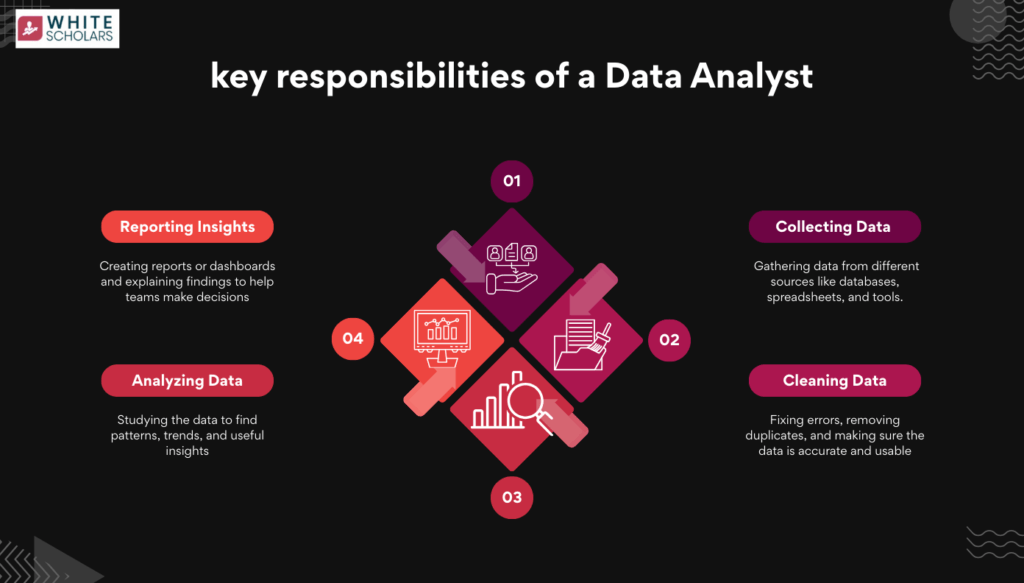
A data analyst has many things to do. One of the most important tasks is data collection, in which data is extracted from databases, spreadsheets, APIs, or the internet. After this, the data cleaning process follows, where missing values, duplicates, and incorrect values are handled. This in itself consumes up to 60-70% of the analyst’s time.
Another important task is data analysis, in which trends, patterns, and correlations are determined using statistical techniques. Analysts are also required to prepare graphical reports and dashboards to communicate insights to non-technical audiences. In addition, documentation and reporting are done to ensure that results can be referred to and reused. It is important to understand these in order to help us prepare for the actual working environment.
Build Strong Foundation Skills Before Advanced Learning
Foundational skills need to be learned perfectly before progressing to more complex topics in data analytics. Basic math and statistics knowledge is necessary since data analysis involves numerical problem-solving. Averages, percentages, probability, and distributions are common concepts.
Logical reasoning and problem-solving skills are also necessary for us to improve. Data sets may have errors and missing data, which need to be addressed properly. Communication skills should also be acquired since data analysis results need to be communicated to people who are not technically sound. These skills are generally included in a complete data analyst course, which makes it simpler for a fresher to learn especially in Hyderabad.
Core Technical Skills to Focus On
A fresher should aim to learn skills that are in common use in the industry. The following skills are considered necessary:
- Excel is used for data cleaning, removing duplicates, using formulas, and creating pivot tables to summarize and analyze large datasets effectively.
- SQL is used for data retrieval from databases, filtering data, and extracting data that is relevant for analysis.
- Python helps in cleaning, and also organizing and automate data tasks, especially when working with large datasets, using libraries like Pandas and NumPy
- Statistics is used for proper data interpretation by recognizing trends, patterns, and correlations.
- Data Visualization is used to communicate insights effectively using charts and dashboards.
These are generally taught during professional data analytics courses, with examples provided for clarity
Learn the Right Tools Used in Data Analytics
Learning the right tools is an important thing in becoming a successful data analyst. The tools help you to process a huge amount of data and turn numbers into valuable insights. Studies show that over 80% of data analyst job roles require Excel and SQL skills, making them the most essential skills for beginners.
Excel is commonly used for data cleaning, formula creation, and quick analysis. SQL helps you extract and process data from databases, which most companies rely on on a daily basis. Python is also becoming popular, especially for advanced analysis and automation when dealing with huge datasets. Tools like Power BI and Tableau are used to create dashboards that help decision-makers quickly grasp trends and outcomes.
When beginners learn these tools hands-on, they automatically gain confidence. Most data analytics coaching classes in Hyderabad include real-world projects that help learners apply what they have learned, especially such projects, which are taught in depth in some of the data analytics courses at the institute. Knowing the right tools not only makes life simpler but also improves job prospects in the current competitive job market.
Gain Practical Experience Through Projects and Practice
Practical experience is one of the most important factors in data analytics for a beginner. This is because employers demand not only theoretical knowledge but also the ability to apply problem-solving skills to real-world data. In fact, research has shown that applicants with project experience have a 40% higher chance of being shortlisted for an entry-level data analyst role.
Projects enable you to understand how real-world business problems are addressed using data. You can choose to analyze sales data to determine seasonal trends or marketing data to determine successful campaigns. Projects also make you more comfortable with tools and enhance your analytical skills.
Case studies, mini-projects, and capstone projects on GitHub-like platforms are a great way to showcase your skills in a portfolio. Many data analytics courses in Hyderabad assist beginners in working on these projects. The more projects you work on, the faster and more precise you become, which is an essential requirement for real-world business data analytics.
Common Mistakes Beginners Should Avoid
Many freshers in data analytics can actually slow down their learning process by making a few common mistakes. The bright side is that these problems can be prevented by using the right mindset and a bit of planning.
- Focusing only on theory: One common mistake is concentrating on theory alone. Studying concepts without actually using them practically makes it more difficult to fully grasp and gain confidence in them.
- Skipping data cleaning practice: Another error is overlooking data cleaning. Many freshers do not understand that data cleaning actually consumes a huge portion of an analyst’s work and is a must for obtaining correct results.
- Learning too many tools at once: Some freshers also attempt to learn multiple tools simultaneously. This usually results in confusion and poor foundation.
- Ignoring business context: Ignoring the business aspect of data is another problem. Data analysis always needs to have a purpose or answer to a question regarding his/ her project.
- Lack of consistency: Irregular practice can actually slow down skill development, as continuous practice is a huge factor in improving and retaining what you have learned.
Conclusion
Planning for the future before becoming a data analyst is an important step for freshers and beginners. The area of data analytics has immense opportunities for development, but it requires planning and understanding. Correct knowledge about the profession enables learners to achieve the right goals. A solid foundation in mathematics, statistics, and logical concepts is the key to advanced learning.
Learning the right tools and technologies increases the efficiency and readiness for the demands of the profession. Hands-on experience with projects boosts confidence and enables learners to implement concepts in practical scenarios. According to career forecasts, the employment level in the data science field is expected to rise by more than 25% in the next decade, and hence, early planning will be even more productive.
Choosing a learning path plan with professional data analytics training in Hyderabad can help freshers. These training programs help learners in gaining a learning path plan, hands-on training, and industry exposure. With hard work, planning, and practice, freshers can build a successful and sustainable career in data analytics. Taking the first step today can open doors to opportunities and development in the future.
FAQs
1. Is data analytics a good career for freshers?
Yes, data analytics is a good career for freshers, as it is in high demand. Companies are heavily dependent on data for decision-making, thus providing ample opportunities. With proper training, freshers can confidently pursue this career.
2. What skills are required to become a data analyst?
A data analyst requires skills in Excel, SQL, statistics, and data visualization. Python programming skills are also necessary for advanced analysis. Communication and problem-solving skills are necessary for effective communication.
3. How long does it take to learn data analytics?
It takes a beginner up to 4 to 6 months to learn data analytics. The time required depends on learning with full interest and consistency and practice. Specialized courses can help in learning data analytics faster.
4. Is coding required for data analytics?
Coding is not required but is highly recommended. SQL is necessary for database-related tasks, and Python is necessary for automation and advanced analysis. Many tasks can still be done using Excel and data visualization tools.
5. Why choose data analytics coaching in Hyderabad?
Hyderabad offers many quality training institutes with experienced mentors. Courses are aligned with industry requirements and include practical projects. This helps freshers become job-ready quickly.