
Skip to content
WhiteScholars
  • Courses
    • Data Analytics
    • Data Science
    • DevOps
    • Digital Marketing
    • Full Stack
  • Demo
    • Data Analytics Demo
  • Power BI
  • Placements
  • About
  • Hiring Partners
  • +91 8500 52 54 56
Contact Us
  • Courses
    • Data Analytics
    • Data Science
    • DevOps
    • Digital Marketing
    • Full Stack
  • Demo
    • Data Analytics Demo
  • Power BI
  • Placements
  • About
  • Hiring Partners
WhiteScholars AcademyWhiteScholars Academy
Blog, DIgital Marketing Course, Marketing

Organic Social Media vs Paid Ads: Which Should Businesses Use?
October 28, 2026
Organic Social Media vs Paid Ads

Introduction

Social media has become an integral part of building your business. Many companies use social media platforms such as Instagram, Facebook, LinkedIn and YouTube to showcase their products, engage with their customers and build their brand. Business owners often wonder whether they should use organic social media or paid advertising.

Both options can help your business grow. Organic social media can help you engage with your audience by providing them with useful and interesting content. Whereas paid advertising can help you target specific groups by paying to promote your content.

Understanding these two options can help businesses who are considering using Digital marketing in Hyderabad. depending on your goals, budget and audience, you can decide which is the best option for your business. whether you’re a start-up, small business or large company.

This blog will cover how social media and paid advertising can help your business along with the pros and cons of each option. we will also discuss how you can use both to achieve better results.

What Is Organic Social Media?

Organic social media is any content you post for free on your social media accounts. This can include posts, stories, reels or carousels. This could be random posts or carefully planned content.

While you can post content to help promote your business, it’s more effective to create content around a content marketing strategy. This can include showcasing your people, values and processes behind your brand or creating content that is shareable and could go viral. This helps to build credibility and trust with your potential customers. You can share content around key milestones, events, community engagement or industry insights.

Consistently posting content and engaging with your audience can help to boost your online presence. Using features like bio links, hashtags and trending content can make your organic social media more relevant and engaging. Some platforms such as Instagram also provide tools for businesses to track key metrics.

What Are Paid Ads?

Paid ads are posts or videos you pay to promote. You can target specific people to see your post by setting a budget.

For example, you can pay to target women aged between 25-40 in your city who like fitness. Facebook, Instagram, LinkedIn, YouTube and X (Twitter) all provide this option.

Paid advertising can help you:

  • Reach new people quickly
  • Target a specific audience
  • Showcase a clear offer such as a sale or free trial
  • Get real data from your results

It’s like putting up a billboard on a busy road. While more people will see you, you will have to keep paying.
Organic Social Media vs Paid Ads

Benefits Of Organic Social Media Marketing

There are many benefits to using Organic Social Media. Especially if you’re looking to build your brand over time.

1. Helps Build Trust With Customers

Customers are more likely to engage with your business if they find your content useful. Providing tips, answering questions and showcasing real customer experiences can help to build relationships with your audience.

For example, if you are a clothing brand, you can post styling tips and outfit combinations. This will give your followers a reason to engage with your brand.

2. Build Long-Term Brand Awareness

By regularly posting content, people will get to know your brand name, products and services. Even if they aren’t a customer now, they may recognise your brand when they need your services.

Educational videos, informative posts and useful carousels can be shared by your followers.

3. Build A Community

Social media can be used to engage with customers directly. By replying to comments, answering messages, asking questions and sharing customer experiences you can create a lively community. Customers who feel valued are likely to recommend your business.

4. Understand Your Audience

Organic posts can provide useful data. By looking at comments, shares, saves and other engagement you can see what your audience like.

This can help improve your content and make informed decisions when planning your future campaigns.

Limitations Of Organic Social Media

There are some downsides to using organic marketing.

  • It can take time to build your audience.
  • Reach can be affected by algorithms.
  • It can take time to plan regular content.
  • There is no guarantee your post will gain lots of reach.
  • It can be difficult to generate leads quickly without an audience.

Therefore, you’ll need to be consistent, patient and plan your content.

Benefits Of Paid Social Media Advertising

Paid advertising can help you achieve your marketing goals if planned and managed correctly.

1. Target Specific Audiences

Advertising platforms provide targeting options. This means you can target people based on location, interests, demographics and professional features depending on the platform.

For example, if you’re a training institute you can target relevant audiences in Hyderabad.

Businesses who are investing in digital marketing in Hyderabad can use local advertising to target potential customers.

2. Boost Visibility Quickly

If you’re a new business you may not have many followers and therefore won’t have much organic reach. Paid advertising can help get your business in front of potential customers.

For example, if you’re opening a new branch of your restaurant you can run local advertising to promote your menu, opening offers or special events.

However, this doesn’t guarantee you will get sales. You’ll need to have an attractive offer.

3. Generate Leads And Sales

Paid advertising can encourage people to take certain actions such as visiting your website, completing a form, messaging you or making a purchase.

For example, if you’re a B2B company you can run adverts for free consultations to attract businesses who may need your services.

Having a clear call to action and easy enquiry process can help people take the next step.

4. Easy To Track Results

Advertising dashboards will provide data such as impressions, clicks, cost per click, conversions and cost per result.

This will help you understand which adverts are performing well.

If one advert is generating more quality leads than another you can experiment with different messaging, creatives and audiences to improve your results.

Limitations Of Paid Social Media Advertising

There are a few downsides to using paid advertising.

  • Costs to market.
  • Costs can increase due to competition.
  • Wasteful if not planned correctly.
  • Results can drop once you stop advertising.
  • Can be ignored if repetitive or irrelevant.
  • Require regular monitoring and improvements.

Paid advertising shouldn’t be seen as a guaranteed way to boost your business. A clear strategy and experimenting is key.

Which Option Is More Cost Effective?

It depends on your goals and what results you want to achieve.

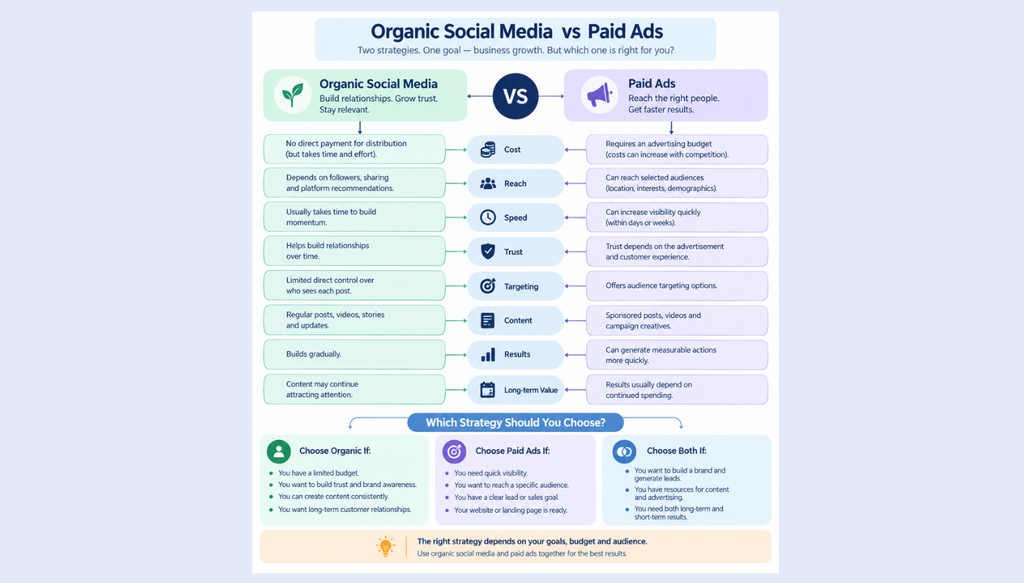
Organic social media is usually cheaper to use as there aren’t any direct costs. This can be a great place to start if you have a small budget. However, you will need to put time and effort into creating content.

Paid advertising will cost you to advertise. However, it can help you reach the right people quicker. If you’re generating quality leads or profitable sales at an acceptable cost it can be worth the investment.

For example, if you are a small clothing business and regularly post product images, styling tips and customer reviews you may start to build an audience and receive enquiries.

If you’re launching a new product and want to promote it before a seasonal sale, using paid advertising can help you reach potential customers.

Both options can be useful. When comparing the two options consider the costs of creating content, advertising costs, quality of leads, conversion rates and revenue.

Which Option Should Small Businesses Use?

Small businesses don’t always need to use one option. It depends on what you need currently.

Use Organic Social Media If:

  • You have a small marketing budget.
  • If you want to build trust and brand awareness.
  • Can consistently create useful content.
  • Want to build relationships with your customers.
  • Want to understand your audience before advertising.

Start by choosing one or two platforms your target audience uses regularly. Create content to answer common questions and show how your products/services can help.

Use Paid Advertising If:

  • You need to promote something time sensitive.
  • If you want to target specific audiences.
  • Have clear goals to generate leads/sales.
  • Website/landing page is ready.
  • Have money to experiment and improve.

Start with a reasonable budget and monitor results.

Use Both If:

  • You want to build your brand and generate leads.
  • Have resources to create content and advertise.
  • If you want to promote specific content to a wider audience.
  • Need long term visibility and short term results from your campaigns.

For many businesses using a mix of both options will create a more balanced marketing strategy.

When Should You Use Organic Social Media?

Organic social media is a great option if:

You have a small budget. If you’re just starting out and don’t have much money to spend, organic is the safest option to start with.

  • If you want to build trust. If your business relies on relationships such as coaching, consulting, local services or creative work then it’s really important to show your face and work.
  • If you want long term growth. If you’re building your brand for the future, having regular organic content is a great base.
  • If you want to engage with your current customers. Social media is a great way to answer questions, keep people updated and engage.

For example, a small bakery can post daily baking videos, show new products and respond to comments. Over time people in the area will start to recognise and love your brand without spending a single rupee on advertising.

When Should You Use Paid Advertising?

Paid advertising makes more sense if:

  • You need quick results. If you’re launching a new product, running a sale or promoting an event you can’t wait months for organic results.
  • You know what sells. Paid advertising works best if you know your product sells well. It will help make a good product even better. It won’t help if your product isn’t great.
  • You want to target cold audiences. If most people haven’t heard of you, advertising is the fastest way to get in front of them.
  • You have a budget and can track results. If you have money to spend, experiment and learn then advertising can become a reliable source of leads and sales.

For example, an online clothing store can run advertising to show their new collection to women in specific cities. You can track exactly how many sales each advert has generated.

The Best Answer – Use Both!

Most businesses learn over time that it’s not really an either/or situation. They work best together.

Think of it like this. Organic social media builds your reputation and paid advertising helps spread your reputation to more people.

They can help each other in the following ways:

  1. Try Organic And Boost With Paid. Post different types of content and see what people like. Once you’ve found a post that performs well, spend some money on boosting it. As you know people like this content your advert is more likely to work.
  2. Use Paid To Get People In And Organic To Keep Them. You may get a new person to visit your page via an advert. However, once they see your helpful content and real customer comments they’ll feel more comfortable purchasing from you.
  3. Retarget Interested People. If someone has watched your video or visited your website but hasn’t purchased it, you can show them an advert. As they’ve been warmed up by your organic content your advert will give them that final push.
  4. Use Organic As Proof. Using real reviews, customer images and honest testimonials from your organic content will make your adverts more credible.

How Can Businesses Use Both Options?

Businesses can use both options.

1. Decide On Your Goals

Decide what you want to achieve. This could be increasing brand awareness, driving traffic, generating enquiries or increasing sales.

This will help you decide what content and advertising to use.

2. Create Useful Organic Content

Create content that helps your audience. This could include tutorials, common mistakes, customer stories, industry updates and FAQs.

For example, if you’re a digital marketing company in Hyderabad you can post practical tips on SEO, website performance and social media marketing. This will help potential customers understand what services you offer and your knowledge.

3. Find Your Best Performing Posts

Look through your social media insights to find posts that are generating meaningful engagement, driving traffic or generating enquiries.

Don’t just look at likes. Some posts may not have as many likes but could be attracting the right customers.

4. Experiment With Paid Advertising

Promote relevant content using paid advertising. This could include promoting a service, event, special offer or useful resource. Start with a reasonable budget and experiment. Just because something is popular with organic content doesn’t mean it will perform the same with advertising.

5. Track And Improve

Track the correct metrics to meet your goals. If you’re looking to increase brand awareness, track reach and engagement. If you’re looking to generate leads, track quality enquiries and cost per lead. If you’re looking to increase sales track conversions and revenue.

Use this to improve your next campaign.

Common Mistakes To Avoid

Avoid the following mistakes to save yourself time and money.

  • No Plan. Don’t just post random content. Create a simple content calendar and post consistently.
  • Expect Quick Results. Organic marketing takes time. Focus on useful content.
  • No Clear Goal. Every advert should have a goal such as generating enquiries.
  • Ignore The Customer Experience. Even if you’re targeting the right people your website may be confusing or your enquiry form difficult to complete meaning you won’t get conversions.
  • Tracking The Wrong Metrics. Just because you have a high reach doesn’t mean you’ll get more sales. Focus on the right metrics.
  • Give Up Too Soon. Give your strategy time to generate useful data and make changes based on real results.

Conclusion

Both organic social media and paid advertising can help your business grow. Organic marketing can help you build trust, engage with your audience and build long term brand awareness. Paid advertising can help you target specific audiences, promote offers and meet specific marketing goals.

Depending on your goals, budget and target audience, businesses investing in Digital Marketing Training in Hyderabad can decide which is the best option for them. Small businesses and start-ups can start with organic content and introduce paid advertising when they’re ready to invest in generating leads/sales.

If you have enough resources you can use both options. Organic content will give you a solid base and paid advertising will help promote your chosen messages to the right audiences.

The most important thing to remember is to understand your audience, create useful content and regularly track your results. Rather than asking which is better, ask yourself which will help you achieve your current goals.

With consistent effort and the right marketing strategy you can improve your online visibility, engage with potential customers and help with long term growth.

FAQs

1. What’s The Difference Between Organic Social Media And Paid Advertising?

Organic social media is content you post without paying to advertise. Whereas paid advertising will cost you to promote your content to a targeted audience. Organic marketing will help build relationships with your audience whereas paid advertising can help increase visibility quicker.

2. Should Small Businesses Use Organic Social Media Or Paid Advertising?

Organic social media is a great place to start if you have a small budget. Paid advertising can help you target specific audiences and generate leads quicker. Using both can help you achieve better results.

3. Are Organic Social Media Posts Free?

Organic posts don’t cost to advertise however you will need to spend time creating content. You may also spend money on graphic design, video editing and social media management.

4. Can Businesses Use Both Organic Social Media And Paid Advertising?

Yes! You can use organic content to build trust and provide useful information. Paid advertising can help you promote offers and reach new customers. Using both will help with brand awareness and generating leads.

5. How Can Digital Marketing Help My Business Grow?

Digital marketing can help improve your online visibility, reach potential customers and generate enquiries. Using a mix of organic social media, paid advertising and other digital marketing strategies can help promote your services and help with long term growth.

  • digital marketing course in hyderabad
  • organic social marketing
  • paid ads
  • PPC marketing
  • social media marketing

Discover Our Best Kept Secrets

WhiteScholars is a Training and Certification Institute in Hyderabad offering 100% interview opportunities. Hands on experience with Online & classroom training with guidance on practical projects. Enroll today and get FREE Demo class. Hands-on project & training from industry experts from a network of 100+ hiring managers. Oracle cloud certification for full stack developer, Microsoft certification for data science & Certification for Digital Marketing.

    Quick Links

    • Data Analytics
    • Data Science
    • DevOps
    • Digital Marketing
    • Full Stack
    • Contact Us
    • Refund & Cancellation Policy
    • Privacy Policy
    • Terms & Conditions

    Contact Details

    Aero Hamd Building, 5th Floor Mumbai Highway Main Road, near JNTU College Metro Station , Opposite Rainbow Children's Hospital Above HDFC Bank Hyder Nagar Branch, Bedside Mem Saheb, Vasant Nagar, Kukatpally, Hyderabad, Telangana 500085

    +91 8500 52 54 56

    info@whitescholars.com

    © Copyright – WhiteScholars Academy 2025

    Scan and register with just 199 Rupees

    Thank you for registering. Our team will reach out to you shortly.

    Start from 21st Sep

    Elite Advanced Data Science Job-Ready Program

    1. Introduction to Programming and Python
    • What is programming?
    • History of Python.
    • Setting up the development environment.
    • IDLE.
    • Jupyter Notebook.
    • VS Code.
    • Writing and running your first Python program.
    Basic Syntax
    • Comments.
    • Indentation.
    • Printing to the console.
    Variables and Data Types
    • Numbers (integers, floats).
    • Strings.
    • Booleans.
    Basic Operators
    • Numbers (integers, floats).
    • Strings.
    • Booleans.
    Control Flow
    • Conditional statements (if, elif, else).
    • Loops (for loops, while loops).
    • Break, continue, and pass statements.
    Functions
    • Defining and calling functions: Function arguments and return values.
    • Scope and lifetime of variables in Lambda functions.
    Data Structures: Lists
    • Creating and accessing lists.
    • List operations (indexing, slicing, adding, removing elements).
    • List methods.
    • append.
    • extend.
    • insert.
    • remove.
    • pop.
    • clear.
    • index.
    • count.
    • sort.
    • Reverse.
    Data Structures: Tuples and Sets
    • Creating and accessing tuples.
    • Tuple methods.
    • Creating and accessing sets.
    • Set operations.
    • union.
    • intersection.
    • Difference.
    Data Structures: Dictionaries
    • Creating, accessing, and modifying dictionaries: Dictionary methods.
    • keys.
    • values.
    • items.
    • get.
    • pop.
    • update.
    Working with Strings
    • String operations.
    • concatenation.
    • slicing.
    • formatting.
    • String methods.
    • find.
    • replace.
    • split.
    • join.
    • lower.
    • upper.
    • Strip.
    File Handling
    • Reading from files.
    • Writing to files.
    • Working with CSV files using the csv module.
    Modules and Packages
    • Importing modules.
    • Standard library overview.
    • Math.
    • Datetime.
    • Random.
    • Installing and using third-party packages (pip).
    Error Handling
    • Understanding exceptions.
    • Try, except, else, finally blocks.
    • Raising exceptions.
    Object-Oriented Programming (OOP)
    • Classes and objects.
    • Attributes and methods.
    • Inheritance.
    • Polymorphism.
    Comprehensions
    • List comprehensions.
    • Dictionary comprehensions.
    • Set comprehensions.
    Decorators and Generators
    • Understanding and using decorators.
    • Creating and using generators.
    Regular Expressions
    • Introduction to regular expressions.
    • Using the re module for pattern matching.
    Advanced Data Handling with Pandas
    • Introduction to Pandas.
    • DataFrames and Series.
    • Reading from and writing to different file formats.
    • CSV.
    • Excel.
    • JSON.
    • Data cleaning and manipulation.
    Data Visualization
    • Introduction to Matplotlib and Seaborn.
    • Plotting graphs and charts.
    • Customizing plots.
    Web Scraping
    • Introduction to web scraping.
    • Using BeautifulSoup and requests.
    • Handling web scraping challenges.
    • Pagination.
    • Dynamic content.
    APIs and Web Services
    • Understanding APIs.
    • Making HTTP requests using requests.
    • Parsing JSON data.
    Working with Databases
    • Introduction to SQL and databases.
    • Using SQLite with Python.
    • Performing a CRUD operation.
    Concurrency and Parallelism
    • Understanding concurrency vs. parallelism.
    • Using the threading and multiprocessing modules.
    Testing and Debugging
    • Writing unit tests with unittest and pytest.
    • Debugging techniques and tools.
    Advanced OOP Concepts
    • Abstract classes and interfaces.
    • Design patterns.
    • Metaclasses.
    Advanced Python Libraries
    • Introduction to NumPy for numerical computing.
    • SciPy for scientific computing.
    • Exploring additional libraries as per interest.
    • TensorFlow for machine learning.
    2. Data Visualization
    2a. Introduction to Data Visualization OOP Concepts
    • Fundamentals of Data Visualization.
    • Importance of data visualization.
    • Key principles of effective data visualization.
    • Overview of common visualization types.
    • Bar charts.
    • Line charts.
    • Scatter plots.
    • Introduction to Tableau and Power BI.
    • Introduction to Tableau: installation, interface overview.
    • Introduction to Power BI: installation, interface overview.
    2b. Data Connection and Preparation

    Tableau

    • Connecting to data sources (Excel, CSV, databases).
    • Data cleaning and preparation.
    • Understanding Tableau data types and relationships.

    PowerBI

    • Connecting to data sources (Excel, CSV, databases).
    • Data cleaning and preparation.
    • Understanding Power BI data types and relationships.
    2c. Basic Visualization Techniques

    Tableau

    • Creating basic charts (bar, line, pie).
    • Customizing charts (colors, labels, tooltips).
    • Using filters and sorting data.

    PowerBI

    • Creating basic charts (bar, line, pie).
    • Customizing charts (colors, labels, tooltips).
    • Using filters and sorting data.
    2d. Advanced Visualization Techniques

    Tableau

    • Creating advanced charts (heat maps, tree maps, bullet charts).
    • Using calculated fields.
    • Parameters and input controls.

    PowerBI

    • Creating advanced charts (heat maps, tree maps, bullet charts), using DAX (Data Analysis Expressions) for calculations, Parameters, and input controls.
    2e. Dashboards and Interactive Reports

    Tableau

    • Designing interactive dashboards.
    • Adding interactivity with actions (filters, highlights).
    • Creating stories for data presentation.

    PowerBI

    • Designing interactive dashboards.
    • Adding interactivity with slicers and filters.
    • Creating reports for data presentation.
    2f. Data Preparation and Cleaning Techniques

    Tableau

    • Data blending.
    • Data joins and unions.
    • Handling null values and outliers.

    PowerBI

    • Data transformation using Power Query.
    • Data joins and merges.
    • Handling null values and outliers.
    2g. Advanced Data Analysis

    Tableau

    • Time series analysis.
    • Forecasting and trend analysis.
    • Cohort analysis.

    PowerBI

    • Time series analysis.
    • Forecasting and trend analysis.
    • Cohort analysis.
    2h. Geographic and Geospatial Analysis

    Tableau

    • Creating maps.
    • Spatial joins and distance calculations.
    • Advanced map visualizations.

    PowerBI

    • Creating maps.
    • Spatial joins and distance calculations.
    • Advanced map visualizations.
    2i. Integration with Other Tools

    Tableau

    • Exporting Tableau visualizations.
    • Embedding Tableau in websites and applications.
    • Connecting Tableau to R and Python for advanced analytics.

    PowerBI

    • Exporting Power BI visualizations.
    • Embedding Power BI in websites and applications.
    • Connecting Power BI to R and Python for advanced analytics.
    2j. Best Practices and Case Studies
    • Best practices for effective data visualization.
    • Design principles.
    • Avoiding common pitfalls.
    • Case studies and real-world applications.
    • Reviewing industry-specific use cases.
    • Hands-on case study analysis.
    3. Statistics
    3a. Introduction to Statistics
    • Descriptive Statistics.
    • Measures of central tendency: mean, median, mode.
    • Measures of dispersion: range, variance, standard deviation, interquartile range.
    • Data Visualization.
    • Histograms, bar charts, and pie charts.
    • Box plots, scatter plots.
    • Probability Basics.
    • Probability theory and rules.
    • Conditional probability and Bayes’ theorem.
    • Probability distributions: discrete and continuous.
    3b. Probability Distributions
    • Discrete Distributions.
    • Bernoulli.
    • Binomial.
    • Poisson distributions.
    • Continuous Distributions.
    • Uniform and Normal (Gaussian).
    • Exponential distributions.
    • Central Limit Theorem.
    • Multivariate Distributions.
    • Multinomial distribution.
    • Multivariate Normal distribution.
    3c. Statistical Inference
    • Sampling and Sampling Distributions.
    • Point Estimation and Properties of Estimators.
    • Bias.
    • Variance.
    • Mean Squared Error (MSE).
    • Interval Estimation.
    • Confidence intervals for means and proportions.
    • Hypothesis Testing.
    • Null and alternative hypotheses.
    • Type I and Type II errors.
    • p-values and significance levels.
    • t-tests.
    • chi-square tests.
    • ANOVA.
    3d. Bayesian Statistics
    • Bayesian vs Frequentist methods.
    • Prior, likelihood, and posterior distributions.
    • Bayesian inference and applications.
    4. Machine Learning
    4a. Introduction to Machine Learning
    • Overview and history of machine learning.
    • Types of machine learning: supervised, unsupervised, reinforcement learning.
    • Key terminology.
    • Features.
    • Labels.
    • Training set.
    • Test set.
    • Validation set.
    4b. Data Preprocessing
    • Data cleaning.
    • Handling missing values.
    • Outliers.
    • Feature scaling.
    • Normalization.
    • Standardization.
    • Encoding categorical variables.
    • One-hot encoding.
    • Label encoding.
    • Feature engineering and selection techniques.
    4c. Supervised Learning
    • Linear Models.
    • Linear regression.
    • Logistic regression.
    • Decision Trees.
    • Construction and interpretation of decision trees.
    • Pruning techniques to avoid overfitting.
    • Ensemble Methods.
    • Bagging (Bootstrap Aggregating).
    • Random Forests.
    • Boosting (AdaBoost, Gradient Boosting).
    • Support Vector Machines (SVM).
    • Concept of hyperplane and support vectors.
    • Kernel tricks: linear, polynomial, radial basis function (RBF), K-Nearest Neighbors (KNN).
    • Distance metrics: Euclidean, Manhattan.
    • Choosing the value of K.
    • Gradient Boosting Machines (GBMs).
    • XGBoost.
    • LightGBM.
    • CatBoost.
    • Advanced SVM techniques.
    • Advanced kernel techniques.
    • Support Vector Regression (SVR).
    4d. Unsupervised Learning
    • Clustering.
    • K-means clustering.
    • Hierarchical clustering: agglomerative and divisive.
    • DBSCAN (Density-Based Spatial Clustering of Applications with Noise).
    • Dimensionality Reduction.
    • Principal Component Analysis (PCA).
    • t-Distributed Stochastic Neighbor Embedding (t-SNE).
    • Linear Discriminant Analysis (LDA).
    • Association Rule Learning.
    • Apriori algorithm.
    4e. Model Evaluation and Validation
    • Train-test split.
    • Cross-validation.
    • k-fold.
    • Stratified k-fold.
    • Evaluation metrics for regression.
    • Mean Squared Error (MSE).
    • Root Mean Squared Error (RMSE).
    • Mean Absolute Error (MAE).
    • R².
    • Evaluation metrics for classification.
    • Accuracy.
    • Precision.
    • Recall.
    • F1 score.
    • ROC-AUC.
    4f. Introduction to Neural Networks
    • Perceptron and multi-layer perceptron.
    • Activation functions.
    • Sigmoid.
    • Tanh.
    • ReLU.
    • Backpropagation and gradient descent.
    4g. Introduction to Time Series Analysis
    • Definition and examples of time series data.
    • Components of time series.
    • Trend.
    • Seasonality.
    • Cyclic patterns.
    • Irregular components.
    • Time series vs. cross-sectional data.
    4h. Descriptive Analysis
    • Plotting time series data.
    • Moving averages and smoothing techniques.
    • Seasonal decomposition of time series.
    • STL (Seasonal and Trend decomposition using Loess).
    4i. Stationarity and Differencing
    • Definition of stationarity.
    • Augmented Dickey-Fuller (ADF) test for stationarity.
    • Differencing to achieve stationarity.
    • Seasonality adjustment.
    4j. Autocorrelation and Partial Autocorrelation
    • Autocorrelation Function (ACF).
    • Partial Autocorrelation Function (PACF).
    • Identifying patterns using ACF and PACF plots.
    4k. Time Series Models
    • Autoregressive (AR) models.
    • AR(p) process and Yule-Walker equations.
    • Moving Average (MA) models.
    • MA(q) process and invertibility.
    • Autoregressive Moving Average (ARMA) models.
    • ARMA(p,q) process and parameter estimation.
    • Autoregressive Integrated Moving Average (ARIMA) models.
    • ARIMA(p,d,q) process and model selection.
    • Seasonal ARIMA (SARIMA) models.
    4l. Model Evaluation and Validation
    • Splitting time series data.
    • Training and testing sets.
    • Walk-forward validation.
    • Forecasting accuracy metrics.
    • Mean Absolute Error (MAE).
    • Mean Squared Error (MSE).
    • Root Mean Squared Error (RMSE).
    • Mean Absolute Percentage Error (MAPE).
    5. Advanced Machine Learning Concepts
    5a. Deep Learning
    • Convolutional Neural Networks (CNNs).
    • Convolution and pooling layers.
    • Famous architectures: LeNet, AlexNet, VGG, ResNet.
    • Recurrent Neural Networks (RNNs).
    • Vanishing gradient problem.
    • Long Short-Term Memory (LSTM) and Gated Recurrent Unit (GRU).
    5b. Natural Language Processing (NLP)
    • Text Preprocessing.
    • Tokenization.
    • Stemming.
    • Lemmatization.
    • Stopwords removal.
    • Word Embeddings.
    • Word2Vec.
    • GloVe.
    • Sequence Models.
    • RNNs.
    • LSTMs.
    • GRUs.
    • Transformers.
    • Attention mechanism.
    • BERT.
    • GPT models.
    5c. Model Deployment and Productionization
    • Model serving and APIs
    • Containerization with Docker
    • Model monitoring and management
    • Scaling machine learning models in production
    6. Deep Learning Foundations
    6a. Deep Learning Basics
    • Overview of deep learning and neural networks.
    • Key concepts.
    • Neurons.
    • Layers.
    • Activation functions.
    • Loss functions.
    • Introduction to deep learning frameworks.
    • TensorFlow.
    • PyTorch.
    6b. Optimization and Training Techniques
    • Gradient descent and variants.
    • SGD.
    • Adam.
    • RMSprop.
    • Learning rate schedules and techniques to avoid overfitting.
    • Dropout.
    • Regularization.
    • Batch normalization and its impact on training.
    6c. Advanced Neural Network Architectures
    • Convolutional Neural Networks (CNNs).
    • Review of CNNs.
    • Advanced CNN architectures (ResNet, DenseNet, EfficientNet).
    • Techniques to improve CNN performance.
    • Data augmentation.
    • Transfer learning.
    • Recurrent Neural Networks (RNNs) and Long Short-Term Memory (LSTM).
    • Overview of RNNs and LSTMs.
    • Advanced architectures: GRU, Bidirectional RNNs, and Attention mechanisms.
    • Applications of RNNs in time series and sequence modeling.
    6d. Transformers and Attention Mechanisms
    • Introduction to Attention Mechanisms.
    • The need for attention in deep learning.
    • Types of attention mechanisms.
    • self-attention.
    • cross-attention.
    • Applications of attention in various domains.
    • Transformers: Theory and Architecture.
    • The transformer architecture.
    • encoder.
    • decoder.
    • multi-head attention.
    • Positional encoding and its importance.
    • Understanding the transformer model through the “Attention is All You Need” paper.

    Platinum Advanced Data Science Job-Ready Program

    1. Introduction to Programming and Python
    • What is programming?
    • History of Python.
    • Setting up the development environment.
    • IDLE.
    • Jupyter Notebook.
    • VS Code.
    • Writing and running your first Python program.

    Basic Syntax

    • Comments.
    • Indentation.
    • Printing to the console.

    Variables and Data Types

    • Numbers (integers, floats).
    • Strings.
    • Booleans.

    Basic Operators

    • Numbers (integers, floats).
    • Strings.
    • Booleans.

    Control Flow

    • Conditional statements (if, elif, else).
    • Loops (for loops, while loops).
    • Break, continue, and pass statements.

    Functions

    • Defining and calling functions: Function arguments and return values.
    • Scope and lifetime of variables in Lambda functions.

    Data Structures: Lists

    • Creating and accessing lists.
    • List operations (indexing, slicing, adding, removing elements).
    • List methods.
    • append.
    • extend.
    • insert.
    • remove.
    • pop.
    • clear.
    • index.
    • count.
    • sort.
    • Reverse.

    Data Structures: Tuples and Sets

    • Creating and accessing tuples.
    • Tuple methods.
    • Creating and accessing sets.
    • Set operations.
    • union.
    • intersection.
    • Difference.

    Data Structures: Dictionaries

    • Creating, accessing, and modifying dictionaries: Dictionary methods.
    • keys.
    • values.
    • items.
    • get.
    • pop.
    • update.

    Working with Strings

    • String operations.
    • concatenation.
    • slicing.
    • formatting.
    • String methods.
    • find.
    • replace.
    • split.
    • join.
    • lower.
    • upper.
    • Strip.

    File Handling

    • Reading from files.
    • Writing to files.
    • Working with CSV files using the csv module.

    Modules and Packages

    • Importing modules.
    • Standard library overview.
    • Math.
    • Datetime.
    • Random.
    • Installing and using third-party packages (pip).

    Error Handling

    • Understanding exceptions.
    • Try, except, else, finally blocks.
    • Raising exceptions.

    Object-Oriented Programming (OOP)

    • Classes and objects.
    • Attributes and methods.
    • Inheritance.
    • Polymorphism.

    Comprehensions

    • List comprehensions.
    • Dictionary comprehensions.
    • Set comprehensions.

    Decorators and Generators

    • Understanding and using decorators.
    • Creating and using generators.

    Regular Expressions

    • Introduction to regular expressions.
    • Using the re module for pattern matching.

    Advanced Data Handling with Pandas

    • Introduction to Pandas.
    • DataFrames and Series.
    • Reading from and writing to different file formats.
    • CSV.
    • Excel.
    • JSON.
    • Data cleaning and manipulation.

    Data Visualization

    • Introduction to Matplotlib and Seaborn.
    • Plotting graphs and charts.
    • Customizing plots.

    Web Scraping

    • Introduction to web scraping.
    • Using BeautifulSoup and requests.
    • Handling web scraping challenges.
    • Pagination.
    • Dynamic content.

    APIs and Web Services

    • Understanding APIs.
    • Making HTTP requests using requests.
    • Parsing JSON data.

    Working with Databases

    • Introduction to SQL and databases.
    • Using SQLite with Python.
    • Performing a CRUD operation.

    Concurrency and Parallelism

    • Understanding concurrency vs. parallelism.
    • Using the threading and multiprocessing modules.

    Testing and Debugging

    • Writing unit tests with unittest and pytest.
    • Debugging techniques and tools.

    Advanced OOP Concepts

    • Abstract classes and interfaces.
    • Design patterns.
    • Metaclasses.

    Advanced Python Libraries

    • Introduction to NumPy for numerical computing.
    • SciPy for scientific computing.
    • Exploring additional libraries as per interest.
    • TensorFlow for machine learning.
    2. Statistics
    2a. Introduction to Statistics
    • Descriptive Statistics.
    • Measures of central tendency: mean, median, mode.
    • Measures of dispersion: range, variance, standard deviation, interquartile range.
    • Data Visualization.
    • Histograms, bar charts, and pie charts.
    • Box plots, scatter plots.
    • Probability Basics.
    • Probability theory and rules.
    • Conditional probability and Bayes’ theorem.
    • Probability distributions: discrete and continuous.
    2b. Probability Distributions
    • Discrete Distributions.
    • Bernoulli.
    • Binomial.
    • Poisson distributions.
    • Continuous Distributions.
    • Uniform and Normal (Gaussian).
    • Exponential distributions.
    • Central Limit Theorem.
    • Multivariate Distributions.
    • Multinomial distribution.
    • Multivariate Normal distribution.
    2c. Statistical Inference
    • Sampling and Sampling Distributions.
    • Point Estimation and Properties of Estimators.
    • Bias.
    • Variance.
    • Mean Squared Error (MSE).
    • Interval Estimation.
    • Confidence intervals for means and proportions.
    • Hypothesis Testing.
    • Null and alternative hypotheses.
    • Type I and Type II errors.
    • p-values and significance levels.
    • t-tests.
    • chi-square tests.
    • ANOVA.
    2d. Bayesian Statistics
    • Bayesian vs Frequentist methods.
    • Prior, likelihood, and posterior distributions.
    • Bayesian inference and applications.
    3. Machine Learning
    3a. Introduction to Machine Learning
    • Overview and history of machine learning.
    • Types of machine learning: supervised, unsupervised, reinforcement learning.
    • Key terminology.
    • Features.
    • Labels.
    • Training set.
    • Test set.
    • Validation set.
    3b. Data Preprocessing
    • Data cleaning.
    • Handling missing values.
    • Outliers.
    • Feature scaling.
    • Normalization.
    • Standardization.
    • Encoding categorical variables.
    • One-hot encoding.
    • Label encoding.
    • Feature engineering and selection techniques.
    3c. Supervised Learning
    • Linear Models.
    • Linear regression.
    • Logistic regression.
    • Decision Trees.
    • Construction and interpretation of decision trees.
    • Pruning techniques to avoid overfitting.
    • Ensemble Methods.
    • Bagging (Bootstrap Aggregating).
    • Random Forests.
    • Boosting (AdaBoost, Gradient Boosting).
    • Support Vector Machines (SVM).
    • Concept of hyperplane and support vectors.
    • Kernel tricks: linear, polynomial, radial basis function (RBF), K-Nearest Neighbors (KNN).
    • Distance metrics: Euclidean, Manhattan.
    • Choosing the value of K.
    • Gradient Boosting Machines (GBMs).
    • XGBoost.
    • LightGBM.
    • CatBoost.
    • Advanced SVM techniques.
    • Advanced kernel techniques.
    • Support Vector Regression (SVR).
    3d. Unsupervised Learning
    • Clustering.
    • K-means clustering.
    • Hierarchical clustering: agglomerative and divisive.
    • DBSCAN (Density-Based Spatial Clustering of Applications with Noise).
    • Dimensionality Reduction.
    • Principal Component Analysis (PCA).
    • t-Distributed Stochastic Neighbor Embedding (t-SNE).
    • Linear Discriminant Analysis (LDA).
    • Association Rule Learning.
    • Apriori algorithm.
    3e. Model Evaluation and Validation
    • Train-test split.
    • Cross-validation.
    • k-fold.
    • Stratified k-fold.
    • Evaluation metrics for regression.
    • Mean Squared Error (MSE).
    • Root Mean Squared Error (RMSE).
    • Mean Absolute Error (MAE).
    • R².
    • Evaluation metrics for classification.
    • Accuracy.
    • Precision.
    • Recall.
    • F1 score.
    • ROC-AUC.
    3f. Introduction to Neural Networks
    • Perceptron and multi-layer perceptron.
    • Activation functions.
    • Sigmoid.
    • Tanh.
    • ReLU.
    • Backpropagation and gradient descent.
    3g. Introduction to Time Series Analysis
    • Definition and examples of time series data.
    • Components of time series.
    • Trend.
    • Seasonality.
    • Cyclic patterns.
    • Irregular components.
    • Time series vs. cross-sectional data.
    3h. Descriptive Analysis
    • Plotting time series data.
    • Moving averages and smoothing techniques.
    • Seasonal decomposition of time series.
    • STL (Seasonal and Trend decomposition using Loess).
    3i. Stationarity and Differencing
    • Definition of stationarity.
    • Augmented Dickey-Fuller (ADF) test for stationarity.
    • Differencing to achieve stationarity.
    • Seasonality adjustment.
    3j. Autocorrelation and Partial Autocorrelation
    • Autocorrelation Function (ACF).
    • Partial Autocorrelation Function (PACF).
    • Identifying patterns using ACF and PACF plots.
    3k. Time Series Models
    • Autoregressive (AR) models.
    • AR(p) process and Yule-Walker equations.
    • Moving Average (MA) models.
    • MA(q) process and invertibility.
    • Autoregressive Moving Average (ARMA) models.
    • ARMA(p,q) process and parameter estimation.
    • Autoregressive Integrated Moving Average (ARIMA) models.
    • ARIMA(p,d,q) process and model selection.
    • Seasonal ARIMA (SARIMA) models.
    3l. Model Evaluation and Validation
    • Splitting time series data.
    • Training and testing sets.
    • Walk-forward validation.
    • Forecasting accuracy metrics.
    • Mean Absolute Error (MAE).
    • Mean Squared Error (MSE).
    • Root Mean Squared Error (RMSE).
    • Mean Absolute Percentage Error (MAPE).
    4. Advanced Machine Learning Concepts
    4a. Deep Learning
    • Convolutional Neural Networks (CNNs).
    • Convolution and pooling layers.
    • Famous architectures: LeNet, AlexNet, VGG, ResNet.
    • Recurrent Neural Networks (RNNs).
    • Vanishing gradient problem.
    • Long Short-Term Memory (LSTM) and Gated Recurrent Unit (GRU).
    4b. Natural Language Processing (NLP)
    • Text Preprocessing.
    • Tokenization.
    • Stemming.
    • Lemmatization.
    • Stopwords removal.
    • Word Embeddings.
    • Word2Vec.
    • GloVe.
    • Sequence Models.
    • RNNs.
    • LSTMs.
    • GRUs.
    • Transformers.
    • Attention mechanism.
    • BERT.
    • GPT models.
    4c. Model Deployment and Productionization
    • Model serving and APIs
    • Containerization with Docker
    • Model monitoring and management
    • Scaling machine learning models in production
    5. Foundations of Generative AI (No shortcuts here)

      Topics:

    • What is Generative AI vs Predictive AI
    • Types:
      • LLMs
      • Diffusion Models
      • GANs
    • Tokens, embeddings, transformers
    • How LLMs actually work
    • Tools:
      • Python
      • Jupyter Notebook
    5a. Working with LLM APIs

      Topics:

    • API usage
    • Prompt engineering
      • Zero-shot, Few-shot
      • Chain-of-thought prompting
    • System vs user prompts
    • Temperature, tokens, cost optimization
    • Tools:

    • OpenAI API
    • Google Gemini
    • Postman
    • Mini Projects:

    • Chatbot with memory
    • AI blog generator

    Still confused of what course to take?

      Still confused of what course to take? Let us help you!!!

        Still confused of what course to take?

          Still confused of what course to take?

            Still confused of what course to take?

              Still confused of what course to take?

                [select* leadsquared-mx_Course_Interested_In "Data Science " "Digital Marketing" "Full-Stack Development" "Data Analytics"

                [submit "Submit request"]

                Still confused of what course to take?

                  [select* leadsquared-mx_Course_Interested_In "Data Science " "Digital Marketing" "Full-Stack Development" "Data Analytics"

                  [submit "Submit request"]

                  Still confused of what course to take?

                    Still confused of what course to take? Let us help you!!!

                      Still confused of what course to take? Let us help you!!!

                        Still confused of what course to take? Let us help you!!!

                          Still confused of what course to take?

                            Still confused of what course to take? Let us help you!!!

                              Still confused of what course to take?

                                Still confused of what course to take?

                                  [select* leadsquared-mx_Course_Interested_In "Data Science " "Digital Marketing" "Full-Stack Development" "Data Analytics"

                                  [submit "Submit request"]

                                  Still confused of what course to take?

                                    [select* leadsquared-mx_Course_Interested_In "Data Science " "Digital Marketing" "Full-Stack Development" "Data Analytics"

                                    [submit "Submit request"]

                                    Still confused of what course to take?

                                      Still confused of what course to take?

                                        [select* leadsquared-mx_Course_Interested_In "Data Science " "Digital Marketing" "Full-Stack Development" "Data Analytics"

                                        [submit "Submit request"]

                                        Still confused of what course to take?

                                          [select* leadsquared-mx_Course_Interested_In "Data Science " "Digital Marketing" "Full-Stack Development" "Data Analytics"

                                          [submit "Submit request"]

                                          Still confused of what course to take? Let us help you!!!

                                            Still confused of what course to take?

                                              Still confused of what course to take? Let us help you!!!