

Programmatic Advertising’s Effect on Digital Marketing: 2026
Discover how programmatic advertising lets businesses show the right ad to the right user in milliseconds and boosts digital marketing results
What is Programmatic Advertising?
Programmatic advertising refers to the automated practice of buying and selling digital ad inventory through marketing technology and algorithmic tools.
Rather than relying on manual negotiations and traditional insertion orders, this system uses software to decide, within milliseconds, whether to bid on a specific impression, how much to pay, and which creative asset to display to the user.
It functions as a sophisticated “behind-the-scenes” expert, utilizing a wide array of signals such as user interests, behaviors, demographics, and the time of day to ensure that every ad placement is strategically positioned for maximum impact.
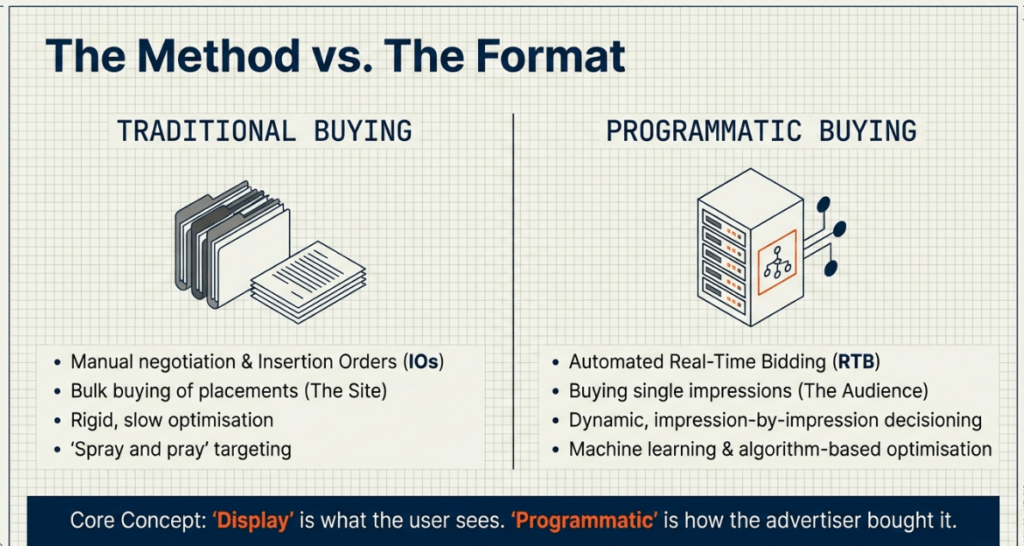
As we look toward 2026, the scale of this field is staggering. In 2024, US digital advertising spend reached $258.6 billion, with programmatic transactions alone accounting for $134.8 billion, representing an 18% year-over-year increase. Currently, programmatic methods underpin the vast majority of digital display buying, capturing a 91.3% share of the US market in 2024.
The landscape is undergoing a massive transformation. Historically focused on simple web banners, programmatic has expanded into Connected TV (CTV), which is forecast to reach $33.35 billion in US ad spend by 2025 as major streaming platforms adopt automated targeting.
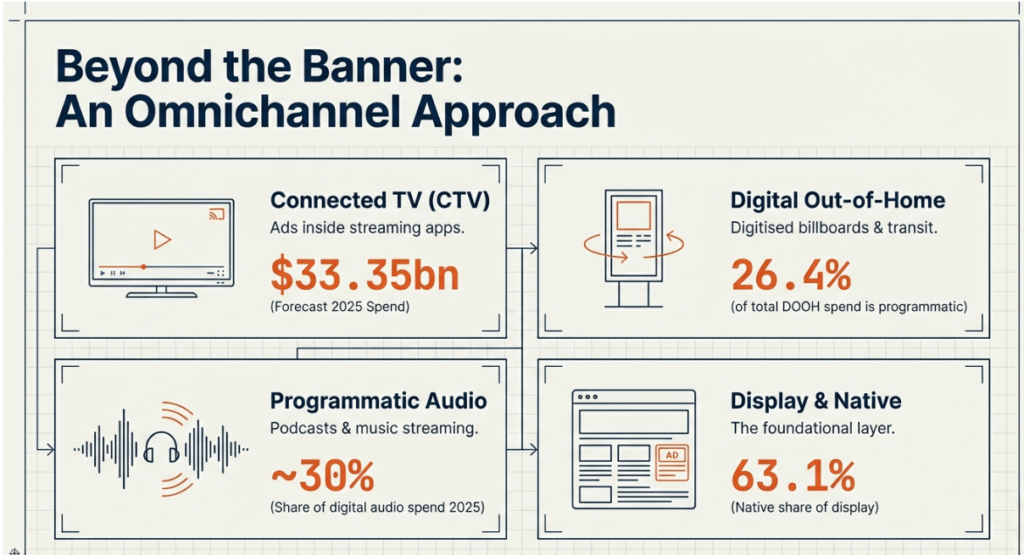
Furthermore, Digital Out-of-Home (DOOH) is becoming increasingly dynamic, with more than a quarter of US DOOH spend now transacted programmatically, allowing for real-time control of screens in transit hubs and city centers.
Generative AI is also reshaping the field, with 65% of organizations already using it on a regular basis to conceptualize ad variants and optimize bidding signals.
The Necessity of Automated Ad Placement
Programmatic advertising has become a requirement for modern brands because it eliminates the waste inherent in traditional media buying. Conventional methods often result in “spillage”, where ads are shown to individuals outside the target audience; programmatic reduces this by ensuring ads only serve to qualified prospects.
It democratises the market, allowing local businesses to access the same high-quality publisher inventory as global corporations by bidding only on individual impressions that meet their specific criteria.
Furthermore, the efficiency of automation is driving higher returns. Recent data shows that $43.90 of every $1,000 entering a demand-side platform now reaches consumers, an increase of $79 per thousand compared to previous years due to cleaner supply paths.
It also provides real-time measurement, allowing advertisers to evaluate campaign effectiveness mid-flight and adjust budgets or creatives instantly rather than waiting for post-campaign reports.
In a privacy-conscious world, it offers a framework to use consented first-party data and contextual signals to maintain reach without relying on invasive tracking.
Comprehensive Analysis of Automated Advertising Components
The Technical Handshake: How the Process Functions
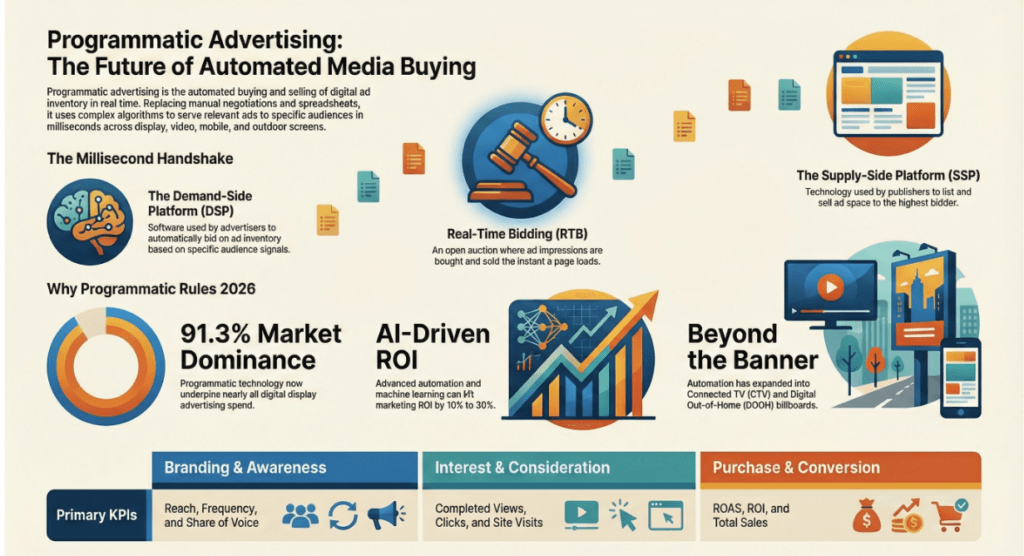
The journey of a programmatic ad begins the moment a person loads a webpage, app, or streaming service. The publisher’s system describes the available ad slot (size, format, location) and sends this as a request to an ad exchange. Demand-side platforms (DSPs) then evaluate this request against an advertiser’s predefined parameters and submit a bid.
The exchange conducts an auction, identifies the winner, and renders the ad on the user’s screen, all in less than a second.
The Core Infrastructure: Platforms and Tools
Several distinct technologies work in unison to facilitate these transactions:
- Demand-Side Platforms (DSPs): These are the “control rooms” for advertisers, allowing them to manage bidding and target audiences across multiple platforms through a single interface. Notable examples include Amazon DSP, Display & Video 360 (Google), and The Trade Desk.
- Supply-Side Platforms (SSPs): Software used by publishers to package and sell their ad inventory to a wide pool of buyers, often setting minimum pricing floors to maximize revenue. Major SSPs include Google Ad Manager and PubMatic.
- Ad Exchanges: Neutral online marketplaces where SSPs and DSPs meet to clear auctions.
- Header Bidding: A technology that allows publishers to request bids from multiple sources simultaneously before calling their ad server, increasing competition and revenue for premium inventory.
Data Management and Privacy Frameworks
In 2026, the fuel for programmatic success will be data, managed through several specialised systems:
- Customer Data Platforms (CDPs): These unify person-level, first-party data (like CRM info) to create durable customer profiles.
- Data Management Platforms (DMPs): Used for aggregating anonymous identifiers to build audience segments for short-term targeting.
- Data Clean Rooms: These enable brands and publishers to match datasets safely (e.g., via hashed emails) without exposing raw personal information, ensuring compliance with GDPR and CCPA.
Transactional Methodology: How Inventory is Purchased
There is no single way to buy programmatic; rather, there are four main models:
- Real-Time Bidding (RTB): An open auction where any advertiser can bid on an impression.
- Private Marketplaces (PMPs): Invitation-only auctions where publishers offer premium inventory to selected buyers.
- Preferred Deals: Fixed-price agreements that give a buyer “first look” at inventory before it hits the open market.
- Programmatic Guaranteed: A direct reservation where the buyer and seller agree on a fixed price and volume upfront, bypassing the auction process entirely.
Diverse Formats and Mediums
Modern programmatic extends far beyond simple banners:
- Video and CTV: Includes in-stream ads (pre/mid/post-roll) and is the fastest-expanding segment.
- Native Advertising: Ads designed to match the editorial look and feel of a website, often resulting in higher engagement.
- Audio: Programmatic insertion into podcasts and music streaming, which is expected to claim 30% of US digital audio ad spend by 2025.
- Digital Out-of-Home (DOOH): Automated delivery on billboards and transit screens based on triggers like weather or time of day.
Success Methodologies for 2026
To win in this environment, advertisers must follow a disciplined plan:
- Audience Segmentation: Moving beyond broad demographics to focus on lifecycle buckets (active, high-value, lapsing) using first-party signals.
- Contextual Alignment: Using semantic classification to place ads near relevant content themes, which serves as a durable signal in a world with fewer cookies.
- Frequency Management: Setting caps across channels to prevent “ad fatigue” and using ad sequencing to tell a story over multiple exposures.
- Omnichannel Integration: Ensuring display, video, and audio ads share a single “audience spine” to reinforce brand messaging.
Navigating Obstacles and Safeguards
The speed of programmatic brings specific challenges that require robust solutions:
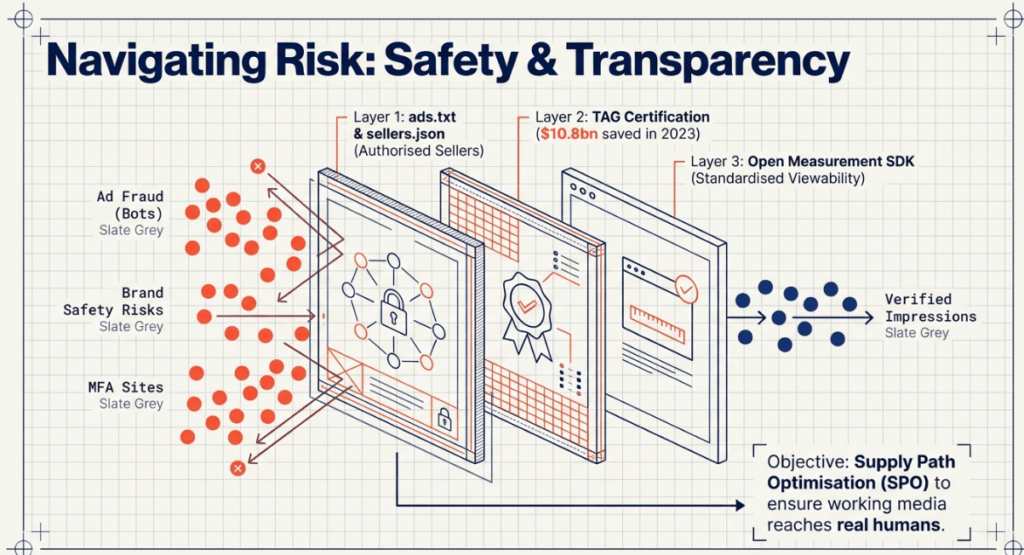
- Ad Fraud: Automation can attract bots. Advertisers should use TAG Certified partners and tools like ads.txt (which declares authorized sellers) to ensure their budget reaches real people.
- Inventory Quality: The rise of “Made-for-Advertising” (MFA) sites can erode ROI. Success requires curating supply paths and using inclusion lists of vetted publishers.
- The Creative Gap: While algorithms optimise delivery, weak creative can stall performance. Research suggests creative accounts for roughly 47% of sales impact, meaning it must be tested and refreshed as rigorously as bidding tactics.
Analytical Frameworks and Metrics
Measurement in programmatic is a multi-layered system:
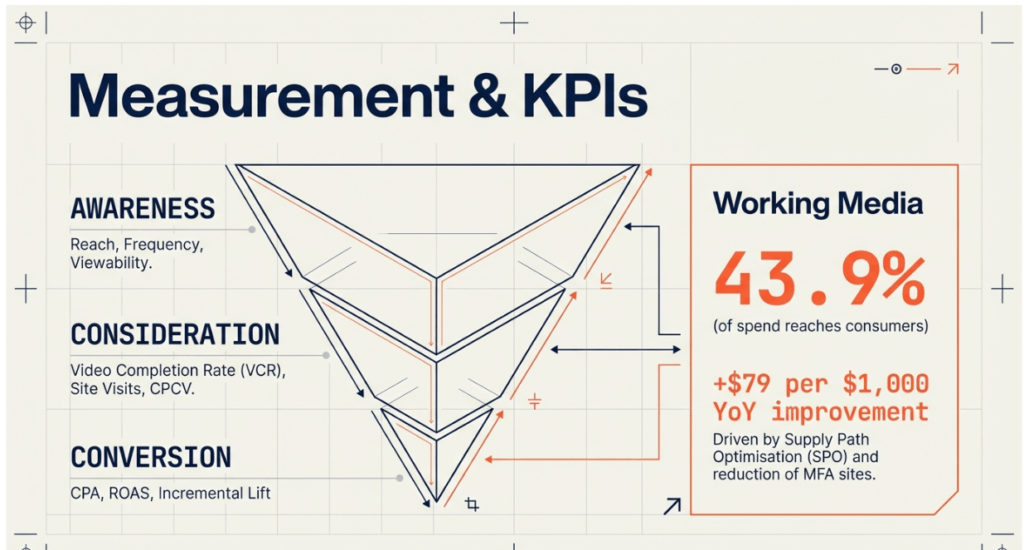
- Awareness Metrics: Reach, frequency, and viewability (ensuring the ad was actually seen).
- Engagement Metrics: Video completion rates and site visit depth.
- Conversion Metrics: Return on Ad Spend (ROAS) and Cost Per Acquisition (CPA).
- Advanced Approaches: Incrementality testing (measuring what would have happened without the ad) and marketing mix modelling (MMM) for long-term budget planning.
Future Horizons: 2026 and Beyond
Several emerging trends shape the field’s future.
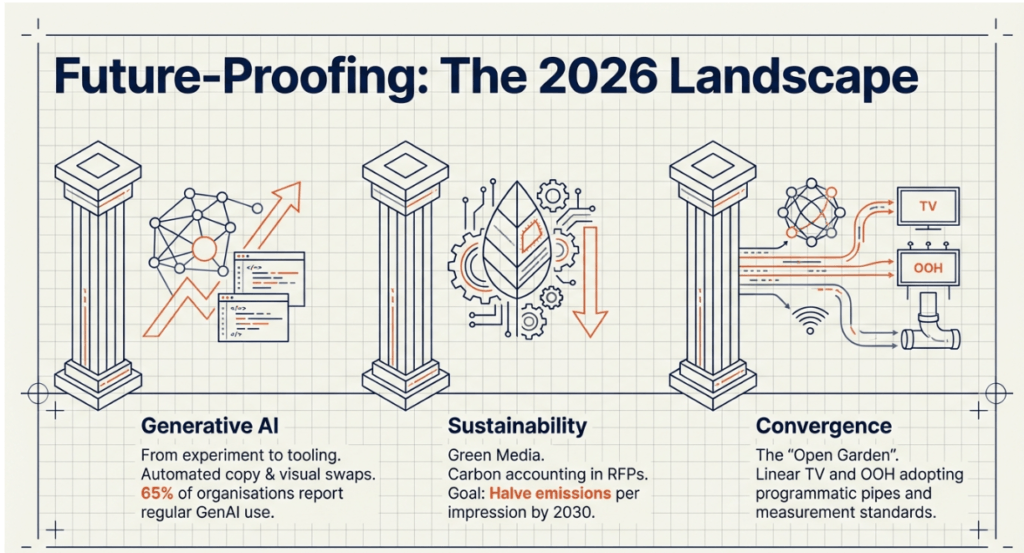
- Sustainability: “Green media buying” is becoming standard, with planners using carbon calculators to choose lower-emission supply paths.
- Convergence: The distinction between digital and “traditional” media is disappearing as TV and OOH adopt programmatic pipes.
- Retail Media Growth: Retailers are increasingly packaging their first-party data for programmatic use, following models pioneered by companies like Amazon and Walmart.
Real-World Evidence: Success Stories
The power of these tools is best illustrated through results:
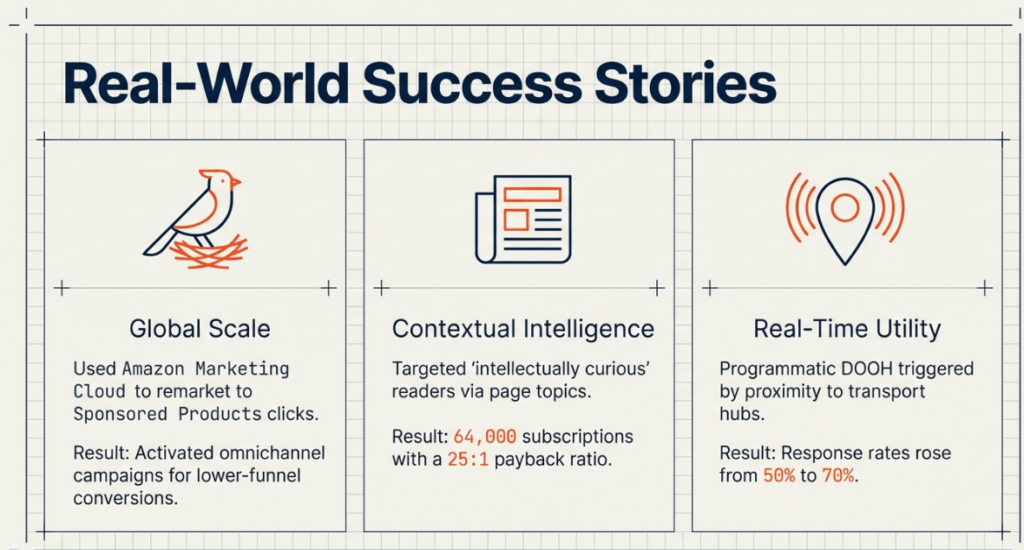
- The Economist: Used contextual programmatic signals to find “intellectually curious” readers, resulting in 64,000 new subscriptions.
- Missing People (UK): Leveraged programmatic DOOH to update digital billboards with the most relevant local appeals in real time, increasing success rates for finding missing individuals from 50% to 70%.
- Amanda Foundation: Tailored animal shelter ads based on user browsing; for example, showing large dog images only to those who had expressed interest in large breeds.
- Aveeno Baby: Utilized a “full-funnel” strategy on Amazon DSP, finding that customers exposed to multiple formats (video and display) had higher purchase rates.
By treating programmatic as a core operating model rather than a side tactic, businesses in 2026 can build a system that compounds learning, reduces waste, and drives reliable growth across all digital touchpoints.
Programmatic Advertising in White Scholar’s Digital Marketing Course in Hyderabad
The digital marketing training curriculum covers several advanced paid advertising and automated marketing strategies that share similarities with programmatic concepts. These include:
- Google Ads (Display & Remarketing): In this course, students learn to run Display Ads and Remarketing Ads. While programmatic advertising often involves automated buying across various exchanges, Google’s Display Network is a significant part of the automated ad ecosystem that students master through hands-on dashboard reviews and account setup.
- Account-Based Marketing (ABM): Module 7 is dedicated specifically to ABM, where students learn about data extraction tools and identifying Ideal Customer Profiles (ICP) to target specific high-value accounts.
- AI-Powered Campaigns: The academy emphasizes AI-driven campaigns and hyper-personalization as key future trends. Students use various AI platforms to enhance search engine strategies and marketing efficiency.
- Performance Marketing: Learners are trained to become Performance Marketing
- Executives. This involves making real-time decisions on audience targeting and budget allocation during live campaigns for partnered brands like Blinkit and Country Delight.
Final Thoughts
Programmatic advertising is no longer just a secondary tactic; it has become the foundational operating model for digital marketing in 2026 and beyond. By automating “behind-the-scenes” decisions, it allows marketers to transition from broad, manual buys to impression-level precision.
This shifts the focus from simple reach to high-impact relevance, ensuring the right message reaches the right person at the optimal moment. Its role is pivotal because it democratizes access to premium inventory across diverse channels, including Connected TV (CTV), Digital Out-of-Home (DOOH), and audio.
With programmatic capturing 91.3% of US digital display spending, it has become the default mechanism for media trading. Furthermore, the integration of generative AI and a shift to consented first-party data ensure the ecosystem’s resilience in the face of changing privacy regulations.
Programmatic advertising removes waste from traditional media by using real-time data to improve ROI. For modern brands, it provides the transparency, efficiency, and scalability required to navigate an increasingly fragmented and automated digital landscape effectively.
Frequently Asked Questions
1. What is programmatic advertising compared to traditional methods?
Programmatic advertising is the automated buying and selling of digital ads using marketing technology. Unlike traditional methods that require manual negotiations and insertion orders, it uses software to deliver ads in less than a second. This system increases efficiency by targeting specific audience signals instead of purchasing impressions in bulk.
2. What are the primary platforms used in the programmatic ecosystem?
The core tools are Demand-Side Platforms (DSPs) for advertisers and Supply-Side Platforms (SSPs) for publishers. Ad exchanges serve as neutral marketplaces where these two platforms trade inventory through automated auctions. These systems work together to manage bidding, audience targeting, and creative delivery across the web.
3. How does the real-time bidding (RTB) process actually work?
When a user loads a webpage, the publisher puts an ad impression up for auction via an exchange. DSPs automatically evaluate this request against an advertiser’s budget and target audience to submit a bid. The highest bidder wins the auction, and their ad is instantly rendered on the user’s screen.
4. What are the different ways marketers can buy programmatic inventory?
Buying models range from open RTB auctions to invite-only Private Marketplaces (PMPs). Preferred Deals offer buyers a “first look” at inventory at a fixed price before it reaches the open market. Programmatic Guaranteed involves direct agreements for a fixed volume of impressions without a bidding process.
5. Why is this field becoming the default operating model for 2026?
By 2026, programmatic will underpin almost all digital media, including connected TV, audio, and digital billboards. It is vital for using first-party data and AI to maintain relevance in a privacy-conscious market. This shift allows for real-time measurement and transparency across all automated advertising channels.