

SEO vs SMM: Where Should Digital Marketers Focus?
This summary provides an in-depth exploration of essential marketing strategies that can help digital marketers decide between SEO and social media marketing.
SEO vs Social Media for Business: Strategic Overview
SEO and social media serve distinct functions in a digital marketing strategy. While many agencies aim to integrate both, not every business will benefit equally from both channels.
The choice between them depends heavily on whether your target audience is actively searching for your solution or if you need to build awareness from scratch.
SEO is primarily a “demand capture” tool, designed to put your business in front of people at the exact moment they are looking for what you offer.
Conversely, social media has evolved from a tool for connecting people to a platform for connecting users with creators based on interests. This makes social media a powerful “demand generation” engine, capable of introducing products to people who didn’t even know they existed.
Understanding the Power of SEO: Capturing High-Intent Leads
SEO is most effective in two specific scenarios. The first is when customers explicitly look for your service. For example, a “weight loss doctor in Mobile, Alabama” would benefit from ranking for that specific location-based keyword because it connects them with a local customer ready to buy.
The second scenario is when people have problems or questions that your product can solve, even if they aren’t searching for the product name yet. A weight loss doctor could provide value by answering questions like “Can I take Ozempic if I’m on high blood pressure medicine?” By answering these informational queries, the business gets in front of its target patient during the research phase.
Key Advantages of SEO:
- Targeting the “Moment of Need”: It places you in front of customers exactly when they are looking for a solution.
- Low Cost Per Lead: Once a website ranks well organically, the cost of acquiring a lead is significantly lower than paid channels.
- Long-Term Asset: Unlike social media, an organic ranking often remains stable for a long period without needing constant daily investment or “feeding”.
The Limitations of Search: When SEO Isn’t Enough
SEO is not a universal solution. Its greatest weakness is that it cannot generate demand for something people don’t know exists. If a business offers a revolutionary service that no one is searching for, SEO will fail to put that business in front of potential clients.
Additionally, SEO is not ideal for reaching specific high-level audiences who do not use Google for procurement. For instance, a Fortune 500 company looking for an enterprise SEO partner is unlikely to search for “SEO company near me”. Therefore, businesses must verify that their target demographic actually uses search engines to solve their problems before investing heavily in this channel.
Further SEO Drawbacks:
- Difficulty in Audience Building: It is hard to build a “following” through a website; most SEO content is read once to solve a specific problem and then forgotten.
- Slow Results: For new websites, it can take months—often 3 to 6 months in medium-competition markets—to see a return on investment.
Social Media Marketing: Building Demand and Expertise
The primary strength of social media today is its ability to reach people based on their interests rather than their search queries.
For a business with a new, unknown product, such as a specific new medical spa machine, social media allows for the creation of educational and entertaining content that builds awareness among people interested in beauty and skincare.
Social media is also significantly better at building and maintaining trust. Through formats like Instagram Reels, TikTok, or YouTube, a business owner can demonstrate their expertise and personality, making the audience feel like they “know” the provider.
This visual and personal connection is much harder to achieve through the written word on a standard blog post.
Key Advantages of Social Media:
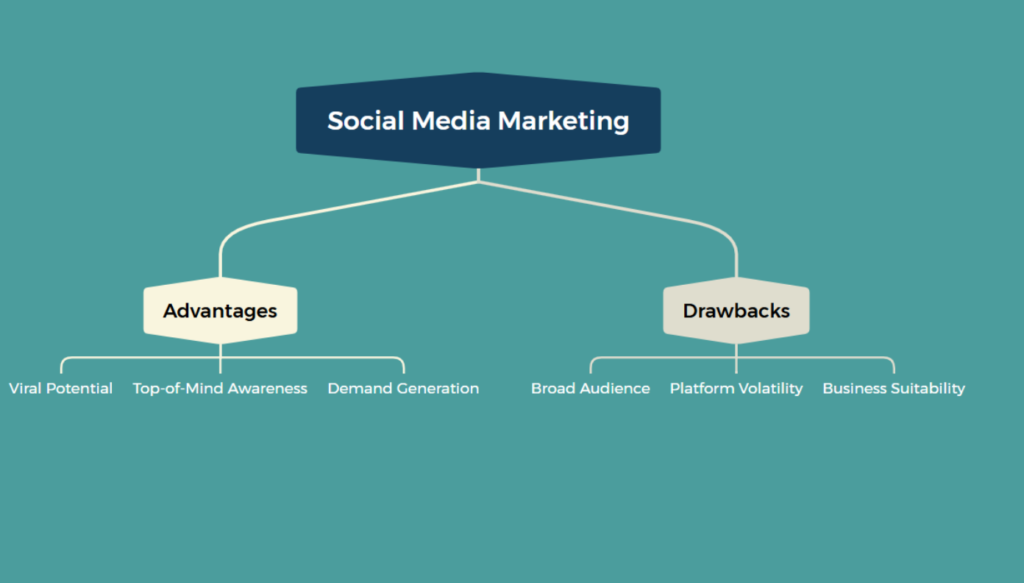
- Top-of-Mind Awareness: Regular posting allows a brand to stay in front of its audience daily, which is nearly impossible with SEO.
- Viral Potential: Unlike the slow burn of SEO, social media accounts can occasionally “blow up” overnight, leading to rapid success and high-value leads in a matter of weeks.
- Demand Generation: It can make people want a product they didn’t know they needed by educating them on its benefits.
The Content Treadmill: Challenges of Social Platforms
Despite its benefits, social media marketing has a higher barrier to entry because it requires consistent production of high-quality video and images. It is much more labour-intensive than writing a landing page or a blog article.
Furthermore, social media requires a constant presence. While YouTube offers some “evergreen” value where old videos can still be found, platforms like TikTok and Instagram require a constant stream of new content to remain relevant—a phenomenon often called the “content treadmill”.
Other Social Media Risks:
- Broad Audience: You often reach many people who have no intention of becoming customers, casting a much wider and less efficient net than targeted search queries.
- Platform Volatility: Platforms go in and out of fashion. Businesses that invested heavily in Facebook followers years ago often see little return today as reach has declined; the same could eventually happen to Instagram or TikTok.
- Business Suitability: Not all businesses are suited to social media. While creative content can work for almost any niche, some industries, like home care agencies, often struggle to find a primary lead generation channel on social media.
Integration Strategy: The Best of Both Worlds
The most effective marketing approach is to integrate SEO and social media to create a self-reinforcing loop. By producing a video for YouTube, a business can embed that video into a blog post, use the transcript to optimise the page for search, and then cut the video into smaller snippets for TikTok, Reels, and LinkedIn.
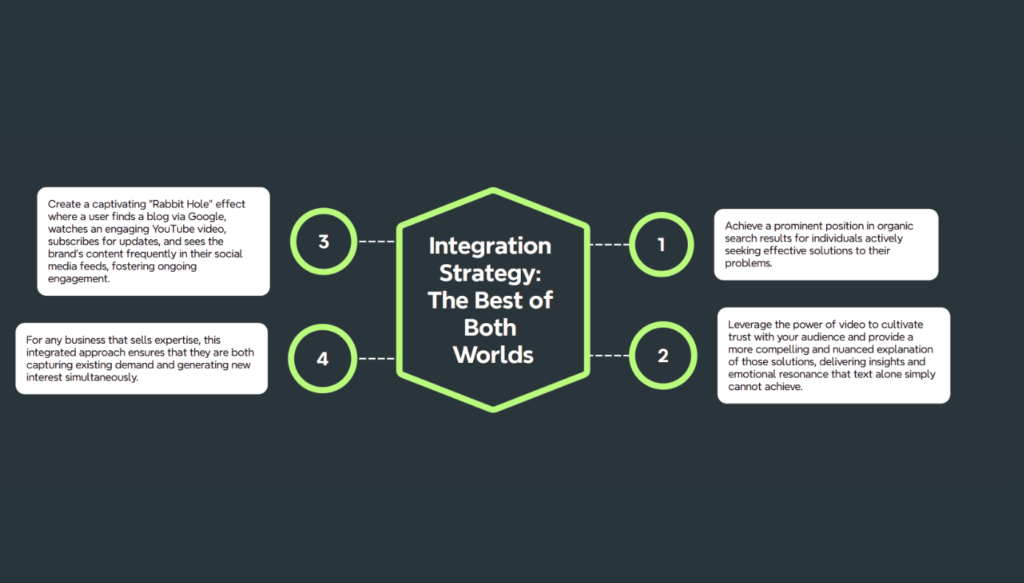
This “best of both worlds” approach allows a business to:
- Achieve a prominent position in organic search results for individuals actively seeking effective solutions to their problems.
- Leverage the power of video to cultivate trust with your audience and provide a more compelling and nuanced explanation of those solutions, delivering insights and emotional resonance that text alone simply cannot achieve.
- Develop an engaging “Rabbit Hole” effect, in which a user initially discovers a blog through a Google search, subsequently clicks through to an informative YouTube video that captivates their interest, subscribes to the channel for ongoing updates, and ultimately begins to see the brand’s content appearing regularly in their social media feeds, creating a continuous loop of engagement and interaction with the brand’s offerings.
For any business that sells expertise, this integrated approach ensures that they are both capturing existing demand and generating new interest simultaneously.
To understand this integration of SEO and SMM better, enrol in the best digital marketing course in Hyderabad powered by AI.
Final Thoughts
Choosing between SEO and social media is not about picking a winner but about understanding your business goals and target audience behaviour. SEO excels at capturing existing demand.
If customers are actively searching for your service or solutions to specific problems, appearing in search results provides a high-intent, low-cost lead source that functions as a long-term asset. However, SEO is limited because it cannot put you in front of people who don’t know your solution exists.
Social media serves as a powerful engine for demand generation, introducing your brand to users based on their interests rather than active queries. It is vastly superior for building trust and demonstrating expertise through video, allowing for a personal connection that written text often lacks. While it requires a more consistent “content treadmill” and higher production effort, the potential for rapid growth is a significant advantage over the slow burn of SEO.
The most effective strategy involves integrating both channels. By repurposing video content into SEO-optimised blog posts, businesses can create a “rabbit hole” effect that captures search traffic and converts it into long-term social followers. This holistic approach ensures you are visible in the moment of need while remaining top-of-mind through daily engagement.
Frequently Asked Questions
1. Which is better for a brand-new product no one knows about?
Social media is the ideal choice because it can generate demand by educating and entertaining users based on their interests. SEO cannot help if no one is searching for the specific solution or the problem it solves.
2. How long does it take to see results from SEO?
For most medium-competition markets, it typically takes 3 to 6 months to see a return on investment through organic search. While social media can occasionally yield results “overnight” through viral content, SEO is a long-term strategy.
3. Can every business succeed on social media?
Not necessarily; some industries, like home care agencies, often struggle to find success as a primary lead generation channel on social platforms. Success in not-so-well-suited niches requires significant creativity to make the content compelling enough for people to follow.
4. What is the benefit of integrating SEO and social media?
Integration allows you to repurpose content, such as using video transcripts for SEO blogs, to capture searchers and turn them into social subscribers. This approach ensures you are both capturing existing demand and generating new interest simultaneously.
5. What are the specific steps for integrating SEO and social media content?
A business should upload a video to YouTube, embed that video into a blog post, and then use the transcript to optimise the page for search. Additionally, the same video should be cut into smaller snippets for platforms like Instagram Reels, LinkedIn, and TikTok to maximize reach and drive traffic back to the website