

Skills vs Degree: What Matters Most in Tech & Marketing Careers
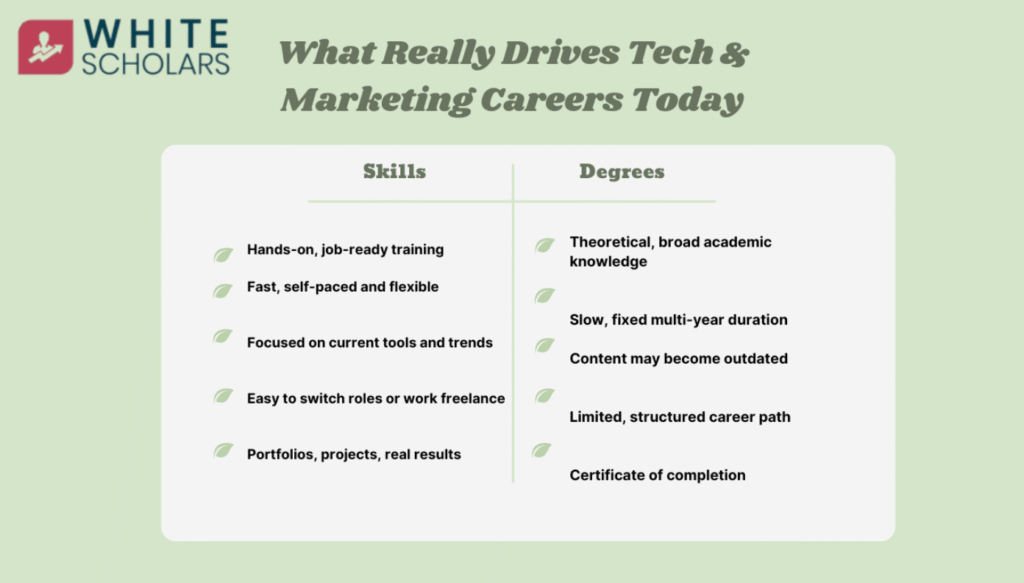
Table of Contents
Skills vs degree explained. Discover what truly drives success in tech and marketing careers today and why skill-based hiring is changing the future.
The Changing Hiring Landscape
Recent studies reveal the emergence and prominence of a major change that has been witnessed within talent acquisition processes, especially within the technology and internet marketing field. As highlighted within the LinkedIn Future of Skills Report 2024, employers now look more at a person’s ability to do the job and practical skills rather than their educational qualifications.
This represents a paradoxical shift within the conventional talent and acquisition tradition, which has traditionally valued education above all else.
The data speaks volumes. More than 55% of the professional workforce in the field of data, software, or digital marketing comes from non-traditional or non-technical backgrounds.
Furthermore, the fact that 61% of hiring managers believe a candidate’s experience is more valuable than their educational credentials, especially in the field of critical technologies, cannot be discounted. Such is the pace of innovation in certain rapidly advancing technology areas like AI, data analytics, and digital marketing, where skills are rendered obsolete after only 2–3 years.
Further research indicates that almost 75% of hiring managers are now utilizing assessments based on skills, portfolios, or Case or Skill-Based Tests. The chances of a candidate being interviewed are substantially higher if they possess experience in dealing with actual situations in a real-world manner. In fact, professionals with strong job-ready skills receive up to 2x more interview calls than those who just have academic qualifications.
These are increasing levels of significance on job readiness: being able to apply knowledge, learn new technology, and produce measurable outcomes. The employer is no longer as concerned with who has a degree as with what a person can do when hiring a candidate.
What this blog will demonstrate is how skill sets and degrees have been measured for today’s job market, what actually works for hiring managers, and why continuing hands-on learning is no longer just a nice-to-have for people that work in technology. This information is important whether you are a college student, someone planning a career change, or a professional with years of work experience.
The Traditional Role of Degrees: Still Valuable, But Limited
Degrees have historically been the benchmark for credibility and structured knowledge. They provide:
- Understanding the “core concepts” is “having a good working understanding of the fundamental ideas behind the way things work.” This enables the “professional to know why a particular process or strategy is employed, as well as the way.For example, a person with conceptual understanding in the field of marketing can apply this understanding in that specific area.
This level of conceptual understanding guarantees that the professional can be able to apply their skills in new ways. A person with conceptual understanding in the field of technology can apply their understanding in that area, among other areas.
- Analytical Skills: Analytical thinking refers to capabilities in which a person is able to separate complicated problems into smaller parts and utilize logic to conclude decisions based on specific data analysis tasks.
Analytical skills help in activities such as solving problems, forecasting, and discerning trends in a relevant and analytical manner by professionals in marketing campaigns, software solutions, and other related business processes
- Academic depth and Networking Opportunities: Academic depth promotes discipline and structured learning and the evaluation of concepts and prepares professionals to deal with challenges. Moreover, universities and programs offer platforms for networking, allowing students to connect with each other and with mentors and industry leaders, among other opportunities.
For instance, programs such as Computer Science, Business, and Communication Studies help develop critical problem-solving skills.
However, the difference between what one learns in academics and what one needs at work is that many modern-day jobs call for instant application and knowledge of practical tools.
Skills-First Hiring: The New Normal
Employers of all industries increasingly screen candidates based on their skills rather than their credentials. Nowadays, job descriptions read:
- Practical experience in project work
- Tool proficiency
- Problem-solving capability
- Results-oriented achievements
This is due to the business need for tech and digital marketing companies seeking professionals who can learn fast, work with speed, and make measurable contributions from day one.
Skills in Technology Careers: Why They Matter Most
Technology keeps upgrading annually as there are new languages, frameworks, and platforms being developed.
Employers value:
- Logical thinking and problem-solving
- Applying concepts to reality
- Adaptability to new tools
- Portfolio-backed experience
For instance, knowledge in Python, SQL, Microsoft Excel, Power Bi, and Tableau might become more valuable than academic grades. Portfolios on GitHub and practical work experience might be evaluated in terms of ability.
Fact: “Project portfolios” have been shown to have a more significant effect on the hiring process than formal education, according to 72% of tech hiring managers.
Marketing Careers: Execution Over Theory
The digital marketing domain has moved on from ‘theory-based’ strategies to data-oriented execution. The key to success in this domain lies
1. Execution-driven roles
Today, marketing is more inclined towards execution skills and not ‘concept’ theory. One gets judged on the ability to plan, execute, analyze, and optimize performance.
2. Creating and Optimizing Campaigns
- Tailored strategies that are aligned with business needs and audience needs.
- Ad creatives, copy, and targeting should be tested and optimized constantly.
- Analyze various performance metrics to improve engagement and conversion rates.
3. Platform-specific experience
- SEO, Google Ads, and Meta Ads – amongst others are very specialized fields.
- Understand the algorithms on platforms for maximum organic reach or Performance of paid campaigns.
- Make use of services such as Google Search Console, Ads Manager, and Meta Business Suite.
4. Data Interpretation for Decision Making
- KPIs & Metrics Analysis: Trends & Points of Improvement
- Reveal raw data into key insights for future campaigns.
- To support business decisions with evidence.
5. Results visible
- A record of the CTR, CAC, ROI, and other basic parameters.
- Demonstrate to stakeholders the results of the campaign efforts.
- Performance benchmarking to optimize strategies.
6. Hands-on tools experience
- Google Analytics traffic and behavior data analysis
- HubSpot for CRM & Marketing Automation
- SEMrush, Ahrefs, and Moz for SEO
Degrees vs Skills: A Practical Comparison
| Aspect | Degrees | Skills |
| Purpose | Foundational understanding | Immediate applicability |
| Strength | Structured knowledge | Real-world problem solving |
| Relevance | Long-term academic credibility | Current industry relevance |
Observation: Degrees are secondary qualifications; skills are performance and job capability. Experts in both fields will have a greater potential for success in dynamic sectors.
Continuous Learning and Upskilling: A Career Imperative
Upskilling has become not only an optional process but also an imperative process for those wishing to advance their careers in IT, marketing, or any other field. All sectors change at such fast rates that if an individual does not upskill, he or she will certainly lag behind.
Why Upskilling Matters
- Ever-changing requirements in employment: Jobs are becoming more and more specialized. What counted as skills a couple of years back may no longer meet industry requirements.
- Shifting job requirements: Roles are becoming more specialized. Skills that were sufficient a few years ago may no longer meet industry expectations.
- Competitive Advantage: Persons who engage in continuous skill-building activities tend to be given preferential treatment in terms of promotions and leadership positions.
- Increased employability: Employers increasingly prefer candidates with demonstrable, current skills over purely academic credentials.
- Adaptability to change: Upskilled professionals can pivot to new roles or responsibilities as business needs evolve.
Effective Approaches to Continuous Learning
- Short-term, skills-oriented training courses: These need to be highly targeted toward an extremely specific and relevant industry skill, such as Python for data analytics, SEO for digital marketing, for example, or Tableau for reporting. This helps professionals pick up knowledge that is actionable, fast.
- Projects and internships: Learners will have the possibility to put their theoretical knowledge into practice. Finalization of real business projects develops problem-solving skills and self-confidence.
- Tool and Technology Certifications: Certifications are a surefire way to confirm expertise in certain skills, and most employers appreciate working with people who can show evidence of competency in cloud computing, digital marketing, and data visualization, among others.
- Real-world problem-solving exercises: Simulation of business challenges, like campaign optimization, data cleaning, or debugging software, helps professionals build critical thinking and practical skills.
- Mentorship and learning from others: Learning from experience or within communities can greatly improve understanding and expose the learner to practical insights.
- Microlearning and online modules: Short, focused online lessons enable continuous skill upgrades without disrupting work schedules.
Statistically speaking, upskilling has been claimed to be the number one force that acts as a motivation for career advancement related to technology and marketing roles among 58% of the respondents. This is actually equivalent to the influence of continuous learning on their respective career paths
Benefits of Continuous Learning
- Keeping up to date on trends and technology in the industry
- Creating and Developing an Inventory of Competence
- Improving Problem-Solving and Decision-Making Skills
- Enhancing employability resilience and future development prospects
- Providing opportunities for cross-functional employment and greater responsibility
In conclusion, upskilling is not merely an added-value activity but an absolute necessity. Individuals who focus on learning and developing themselves enhance their status as vital resources in the ever-changing world of technology and the market.
What Employers Actually Look For
The following are some of the attributes that recruiters of tech and marketing professionals value in a candidate
- Practical Project Experience
- Problem-solving mindset
- Communication & Collaboration skills
- Tool proficiency
- Cognitive skills
Instead of relying upon credentials, resumes that demonstrate impact, outcomes, and portfolios excel over resumes with credentials.
Finding the Balance: Degrees Plus Skills
A good career involves a good foundation and skills.
- One of the good effects of formal education brought about by degrees
- Skills direct work application and offer instant application value
Skills: Individually, they make up a well-rounded professional who can adapt to change and produce results
Conclusion: Career Success in a Skills-Driven Economy
Today, achieving success in technology and marketing career paths is no longer measured by educational attainment alone. This is because, although educational attainment is beneficial, it is the skills, flexibility, and experience in technology and marketing careers that measure employability.
Those professionals who invest in skills development learning appear to be in a better place to advance in their careers. This change is also reflected in the learning environment. Learning environments such as WhiteScholars Academy reflect a change where skill development focusing on application is also emphasized.
Do you think skills are more important than a degree in today’s employment market, or must you have a balance?
Faq’s
1. Are skills more important than a degree in tech and marketing careers today?
Yes, skills are increasingly prioritized over degrees in tech and marketing roles. Employers focus on practical abilities such as coding, data analysis, SEO, paid ads, and analytics. Demonstrating hands-on experience through projects and portfolios often matters more than formal qualifications. Degrees may open doors, but skills determine career growth
2. Does a degree still have value in modern tech and marketing careers?
A degree still holds value, especially for foundational knowledge and entry-level credibility. It can help candidates understand core concepts and develop structured thinking. However, without practical skills, a degree alone may not meet industry expectations. Employers prefer candidates who combine education with real-world application.
3. Can someone without a technical degree succeed in tech or digital marketing?
Yes, many professionals succeed in tech and digital marketing without a technical degree. Skill-based learning, certifications, and hands-on projects enable career transitions. Industries value problem-solving and adaptability over academic background. Continuous learning plays a key role in long-term success.
4. How do employers evaluate skills during the hiring process?
Employers assess skills through practical tests, portfolios, case studies, and real-world projects. Interviews often focus on problem-solving approaches and applied knowledge. Certifications and internships also support skill validation. This process helps employers identify job-ready candidates.
5. What is the best approach to build a successful career in tech or marketing?
The best approach is to combine foundational education with continuous skill development. Learning industry-relevant tools, working on real projects, and staying updated with trends are essential. Networking and hands-on experience further strengthen career prospects. This balanced approach supports long-term professional growth.