
Small Batches vs Massive Bootcamps: Choosing The Right
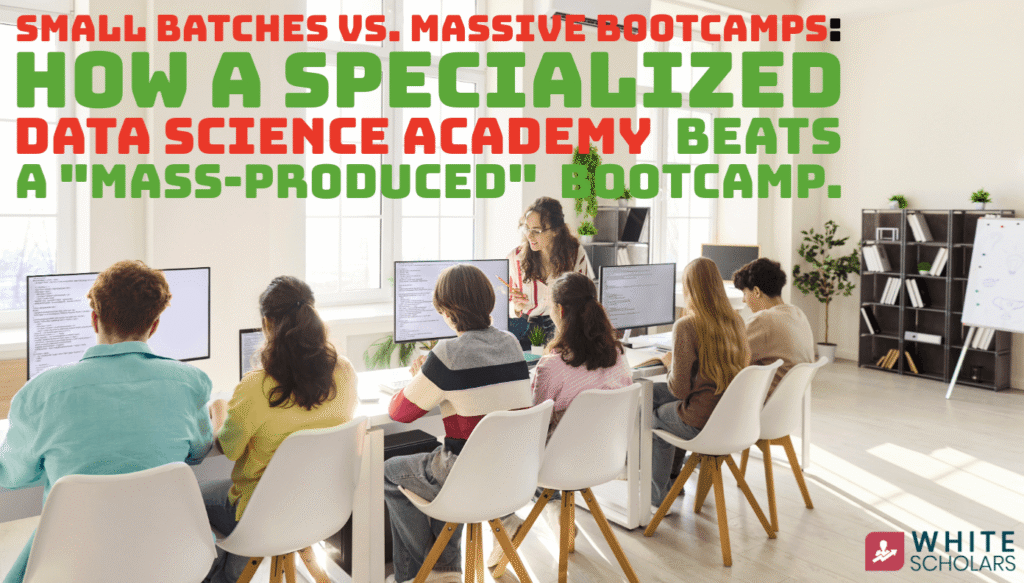
Table of Contents
We break down why small-batch Data Science training delivers better career outcomes than massive online bootcamps and Know the advantages.
How a Specialized Data Science Academy Beats a “Mass-Produced” Online Bootcamp
The Direct Answer: In 2026, tech companies prioritize “Problem Solving” over “Certification.” Massive bootcamps provide the latter; small, mentored batches provide the former by focusing on individual logic-building and real-time error handling. If you are struggling to get results from online courses, it is likely because you are consuming content rather than building competence.
Choosing a local, specialized institute for a Data Science course offers personalized mentorship and hands-on lab access that generic online bootcamps simply can’t match. While big-name platforms offer convenience, a local academy provides the regional networking and face-to-back interaction essential for breaking into the competitive tech scene.
What is a Specialized Data Science Academy?
A specialized data science academy is a focused training center, like WhiteScholars they prioritizes deep-dive technical mentorship, small batch sizes, and local industry alignment over high-volume, automated enrollment. Unlike “mass-produced” bootcamps, these institutes focus on mastery rather than just completion certificates.
Essential Skills You’ll Gain
- Programming: Python and R proficiency.
- Mathematics: Statistics, Linear Algebra, and Probability (The “Why” behind the “How”).
- Machine Learning: From Linear Regression to LLM Fine-tuning (very relevant in 2026).
- Data Visualization: Mastering PowerBI, Tableau, and Seaborn.
- Deployment: Learning how to actually put a model into a cloud environment.
The “Massive Bootcamp” Trap: Why You’re Not Getting Hired
For years, the Ed-Tech industry has treated education like a factory. They sign up 5,000 students, give them access to a dashboard, and call it a “bootcamp.” But for a beginner, this model is fundamentally broken.
- The Doubt Ghosting: In a massive batch, your “urgent” doubt is just another ticket in a system. Waiting 24 hours for a TA to answer a 1-minute logic error kills your momentum and interest.
- The Passive Learning Loop: Watching 100 hours of recorded video is “Netflixing,” not learning. Most students fall into the trap of watching someone else code without ever writing 10 lines of original, unguided logic.
- The Resume Template: Recruiters are tired of seeing 10,000 applicants with the same “Netflix Clone” or “To-Do List” project. If your project looks exactly like everyone else’s, you aren’t a “top candidate”—you are a commodity.
The WhiteScholars Edge: The Power of the Min-Student Rule
At WhiteScholars Hyderabad, we don’t have “subscribers.” We have students. By limiting our batches to just 20 people, we turn the learning process from a broadcast into a conversation.
1. Immediate Doubt Resolution
When you get stuck at 11:00 AM, you need an answer by 11:05 AM. Our mentors are physically and digitally present to ensure that a small syntax error doesn’t turn into a five-hour roadblock.
2. Activity Saturdays: Building Corporate Muscle Memory
Coding is a blue-collar skill that requires white-collar thinking. Every Saturday, our students engage in supervised, live project work. You don’t just “learn” about APIs; you build, break, and fix them under the eye of a mentor who has worked in the industry.
3. The Customized Portfolio
A Mechanical Engineering student shouldn’t have the same portfolio as a CS student. We help you leverage your background. If you’re from a core branch, we guide you to build Data or Software projects for the Auto or Manufacturing industry—making you the “Subject Matter Expert” that companies are desperate to hire.
Why Local Expertise Matters
- Hyper-Local Networking: Your instructors often work in nearby tech hubs and can provide direct referrals.
- Physical Infrastructure: Access to high-end workstations and collaborative “war rooms” for capstone projects.
- Tailored Curriculum: Courses often adapt to the specific hiring needs of Hyderabad-based MNCs and startups.
Comparison: Local Academy vs. Global Online Bootcamp
| Feature | Specialized Academy (e.g., WhiteScholars) | “Mass-Produced” Online Bootcamp |
| Batch Size | 15–20 Students (Personalized) | 500+ Students (Automated) |
| Mentorship | Face-to-face, real-time | Ticket-based, delayed |
| Curriculum | Flexible & Project-heavy | Rigid & Video-based |
| Job Support | Local referrals & mock interviews | Generic career portals |
The Salary Correlation: Why Mentorship Pays Off
There is a direct link between Personalized Mentorship and High Salary Brackets (6-10 LPA).
- Theory-Only Candidates: Without mentorship these students know “what” a function is but not “why” & “where” to use it. They struggle in technical rounds and usually land in support roles at 3 LPA.
- Productive Candidates: Mentored students understand System Design and Logic. In an AI-driven 2026, AI can write the code, but the mentor teaches you how to think through the architecture. These candidates command 6 LPA+ because they don’t need three months of training after being hired.
How to Choose the Right Data Science Course
If you’re ready to commit, follow these steps to ensure you’re getting real value:
- Check the Instructor’s Pedigree: Ensure they’ve actually built models in a production environment, not just taught them.
- Audit a Live Session: Most reputable places will let you sit in on a class. Feel the vibe.
- Review the Portfolio Requirements: Does the course end with a generic “Iris dataset” project, or something unique like “Predicting Hyderabad Real Estate Trends”?
- Verify Placement Data: Ask for LinkedIn profiles of recent alumni. Honestly, this confused me at first—why wouldn’t everyone do this? It’s the only way to see if the “90% placement” claims are real.
Quick Summary
- Choose Local for better networking and accountability.
- Avoid “Mass-Produced” if you need personalized feedback and struggle with self-paced learning.
- Focus on Portfolio quality over the brand name of the certificate.
- Hyderabad is a Hub: Use the city’s unique position as a tech leader to your advantage.
Moving Forward
If you’re serious about building a career in this, structured training can really help bridge the gap between “knowing about data” and “knowing how to work with data.”
You can also explore related topics like Data Science & Data Analysis or Deep Learning Architectures to see which path excites you most. The field is huge—pick a lane and start driving.
Frequently Asked Questions
Is a Data science course in Hyderabad better than an online degree?
For most, yes. The immediate feedback and local networking opportunities in Hyderabad often lead to faster job placements compared to isolated online learning.
What is the average salary for a Data Science fresher in Hyderabad?
In 2026, freshers can expect anywhere from ₹6 LPA to ₹12 LPA, depending on their project portfolio and technical depth.
Do I need a coding background to join a Data science academy Hyderabad?
Not necessarily. Most specialized institutes offer “bridge modules” to get non-coders up to speed on Python basics before the heavy lifting starts.
How long does it take to become job-ready?
A rigorous, full-time program usually takes 4 to 6 months. Beware of “1-month masterclasses”—they rarely provide the depth needed for interviews.
Are these local certificates recognized by big MNCs?
Yes. Companies like Google, Microsoft, and Amazon (who have massive offices in Hyderabad) value skills and project portfolios far more than the specific logo on your certificate.
