

The 80% Rule of Data Analytics: Cleaning Before Thinking
Discover why 80% of analytics work is data cleaning and how Data Analytics courses in Hyderabad equip you for real-world challenges.
Do you know why data analysts take more time in processing data as opposed to analyzing data? The fact, however, is that most data, when initially obtained, has numerous errors that need correction before any meaningful analysis can take place.
The main challenge when dealing with data involves the fact that data comes from a variety of sources, such as databases, spreadsheets, and applications, as well as user input, among others. This makes data inconsistent, possibly filled with errors.
The process of data cleaning is not only a technical task; it is a critical thinking process where the person analyzing is able to comprehend the data and where they need to clean the data.
Through this blog post, you can find out about data cleaning, the reasons why it is close to 80% of the work done in data analytics, the tools required, and how to become a successful analyst by mastering this skill. This is a practical guide for a student searching for a data analytics course in Hyderabad.
Understanding Data Cleaning and Its Importance in Analytics
Data cleaning is defined as the process of finding and repairing errors, inconsistencies, and inaccuracies in raw data. Real-world data can exist in raw form and is obtained or accessed from numerous sources like databases, APIs, surveys, and spreadsheets, making it untrustworthy if not cleaned.
In any data analyst course for that matter, especially in Hyderabad, Pune, Bangalore, and Chennai, learners come to know that data analysis done on unclean data results in inaccurate insights, further stemming from inaccurate business decisions. Missing data, repeated values, improper data formats, and outliers have been known to diminish results. This is why data analysts end up spending most of their time on data accuracy before any data analysis.
For instance, when a business is analyzing visitor habits on an online store, this could lead to a visitor being recorded more than once or dates being stored in different ways. This would skew results for revenue trends and visitor retention.
Common Data Quality Issues Analysts Face
For a clearer understanding of why data cleaning can take so much time, here are some typical issues facing analysts every day:
- Missing or Incomplete Values
- Duplicate Rows Across Datasets
- Wrong data types (texts instead of numbers)
- Inconsistent naming conventions
- The Outliers that taint results
These challenges are addressed in depth during data analytics training in Hyderabad, where learners practice cleaning real datasets.
Why 80% of Analytics Work Happens Before Analysis
Many new analysts think data analysis is all about creating charts, dashboards, and machine learning models. However, data analysis is much more. Data analysis is what takes place before the creation of any chart, any dashboard, or any modeling.
Data cleansing is a task involving the collection of data in order to verify its integrity and transform it for analysis purposes. No sophisticated analytical tool is able to provide accurate insights in the absence of this task. In professional settings, accurate data is employed for respective financial, marketing, or operational purposes.
A good “data analyst course in Hyderabad” also stresses that quality analysis requires quality data. Data Analysts who do not or cannot take the time to do their analysis properly often experience setbacks and spend unnecessary time trying to troubleshoot their reports or trying to clarify their incorrect answers.
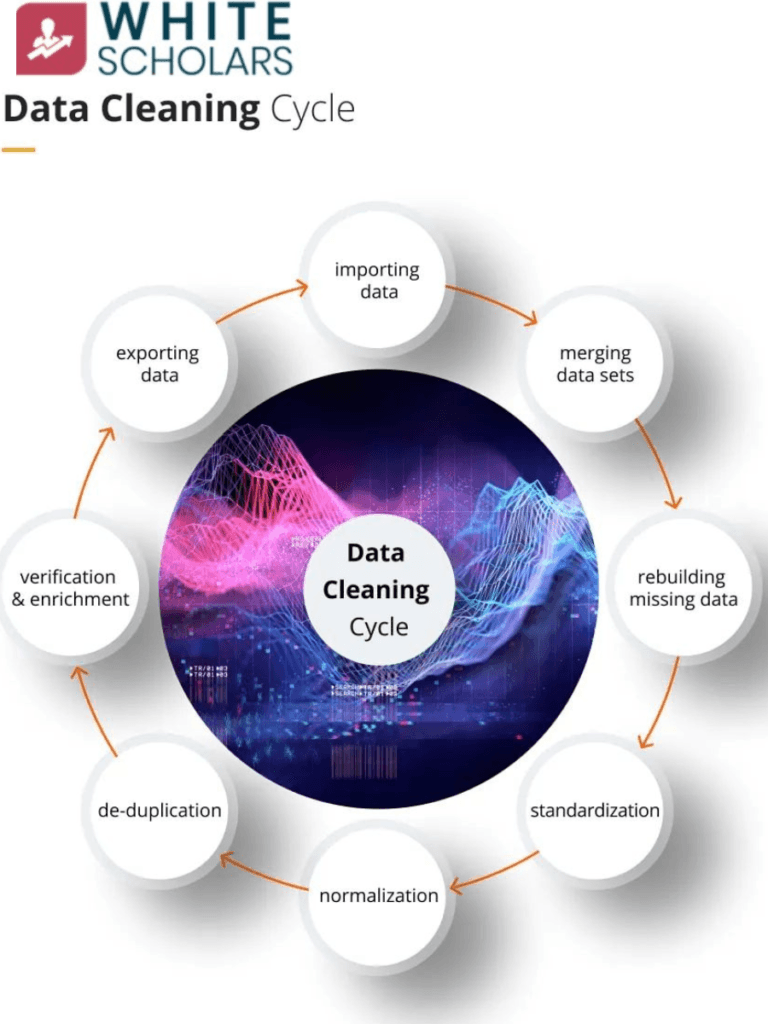
From Raw Data to Analysis-Ready Data transformation generally involves:
- Comprehending the business problem
- Required Datasets Identification
- Data cleaning
- Validation of data
- Standardization Formats
- Preparation of final data for analysis
This organized process is also being imparted in advanced data analytics coaching in Hyderabad, which makes people think like professionals.
Key Data Cleaning Skills Every Data Analyst Must Learn
To achieve success in data analysis, it is important to have skills in data cleaning. Such skills are mandatory, and they consist of the basic element of data analysis practice.
The key skills for data cleaning involve data profiling, logical thinking ability, detail orientation, and problem-solving skills. A data analyst needs to analyze the anomalies in a manner that allows him or her to identify out-of-pattern business activity or data errors.
A person pursuing any course in data analytics at Hyderabad would dedicate substantial time to master these basic skills.
Essential Tools Used for Data Cleaning
Professional data analysts rely on a combination of tools to clean and prepare data efficiently:
- Microsoft Excel for basic processing, filtering, and validation: Microsoft Excel software is applied for basic data processing functions such as removing duplicates, correcting the format of the data, filtering, and validation.
- SQL for removing duplicates, dealing with missing values, and joining tables: SQL assists analysts in handling a database by removing duplicates and dealing with missing values in databases, as well as joining tables.
- Python (Pandas & NumPy) for large data sets & automation: Python (Pandas & NumPy) is best used for cleaning large data sets, automating repetitive data cleaning tasks, or performing complex data transformations.
- R for statistical cleaning and transformation: R has been primarily utilized for statistical data cleaning and transformation, mostly in projects that involve intense statistical processing.
- Power BI & Tableau for Data Modeling & Validation: Power BI & Tableau helps with data modeling & validation by pointing out discrepancies & patterns in the data using visually guided features within these two tools
- Google Sheets for collaborative data cleaning:
Google Sheets provides a collaborative cleaning process where several users can work on a particular problem or dataset or display data for real-time validation.
These tools will be what you will be taught to master in a structured way in training institutes, especially in cities like Hyderabad, Bangalore, and Mumbai, so that industry-ready expertise is gained.
Best Practices to Improve Your Data Cleaning Process
Efficient data cleansing can be achieved by having good technical skills and sticking to a systematic process. Analysts adopting best practices are capable of minimizing errors and saving time during the analysis stage. Organized data cleansing helps to have faith in conclusions drawn from data by ensuring data has been properly cleansed.
One of the most helpful best practices is to document each modification carried out in the dataset. This would include the treatment of missing data, why certain records were removed, and how inconsistencies were resolved.
This helps to ensure the ability to review assumptions and keep the analytics process transparent by allowing the ability to go back and review decisions made. This is particularly helpful if multiple people are working on the same analysis or if there is the need to verify the analysis at a later date.
The other significant best practice is cross-validation for cleaned data. This process involves checking the cleaned data against the original data. This helps ensure that no important information is removed or changed by mistake. Furthermore, it is important that a copy of the raw data be created before any modifications are made. This allows a recovery of important information if needed.
The usage of automated scripts, such as in Python or SQL, also aids in increasing the efficiency of tasks, particularly in the handling of large amounts of data. Students learning data analytics in Hyderabad are advised to adopt a set of repeatable processes in order to ensure that their data cleansing task is reliable and scalable.
Errors to Avoid During the Data Cleaning Process:
There are common mistakes made by many beginners that tend to adversely affect the quality of the data
- Removing missing values without analyzing the effects
- Ignoring outliers without investigation
- Overwriting original data sets without backup
- Data cleaning without understanding business context
These errors can be avoided as a learning takeaway while pursuing professional coaching in data analytics in the city of Hyderabad through discussion on real-life cases.
Conclusion
Data cleansing is the backbone of successful data analytics because it is directly related to the quality of the insights and decisions made using the data. If the data is accurate, complete, and properly organized, there is no scope for doubt in analyzing patterns, trends, and future business opportunities that can boost the growth of business.
That is why nearly 80% of analytical activities occur before the actual analysis takes place if proper data cleansing is not done because even the most sophisticated analytical models and analytical tools fail to give accurate results.
The ability to apply data cleaning techniques effectively will enable budding data analysts to apply a problem-solving approach towards their data. This will enable them to apply their knowledge of business concepts towards analyzing irregularities within the data.
They will also learn the importance of verifying findings rather than accepting data blindly. This is exactly why domain professionals consider it a major asset when a data analyst is proficient in Excel, SQL, Python, Power BI, or a combination of these together.
If one starts learning from a solid foundation of data cleansing, one is sure to excel in the long run because each subsequent skill of analytics requires this to be done.
FAQs
1. What is the purpose of data cleaning in data analysis?
Data cleaning helps in making sure that the data analyzed is accurate, consistent, and reliable. This is because poor data analysis may result in misleading or false information, hence poor business decision-making and loss of trust in data. This makes data cleaning one of the most important topics in any data analytics course.
2. List some tools that are used in data cleaning.
Data analysts utilize software such as Excel, SQL, Python, Power BI, and Tableau for data cleansing. Each software is used differently depending on the size of data and complexity. The software is taught chapter by chapter in a professional course for a data analyst in Hyderabad.
3. Do courses for beginners in analytics include data cleaning?
Yes, data cleaning is one of the first subjects taught in beginner programs. Data analysis training in Hyderabad is heavily dominated by cleaning exercises even before training on visualization or modeling.
4. How long does data cleaning take in real projects?
Data cleaning may consume as much as 70-80% of the entire project period. This of course, is dependent upon the quality and sources of the data. Data analytics training in Hyderabad can certainly help in increasing the efficiency of data cleaning.
5. Can a person be a data analyst without having good cleaning skills?
It is very hard to be a successful data analyst if one is not good at data cleaning skills. This is because organizations want data analysts to be competent in dealing with problematic data. A structured data analyst course in Hyderabad provides you with such an important skill set.