

The Biggest Data Analytics Trends of 2026: How AI and Real-Time Insights Are Shaping the Future
These are data analytics trends to look forward to in 2026, and data products can ensure that enterprises can achieve each of these with ease.
The New Demands in Data Analytics Infrastructure
The world of data analytics is evolving at breakneck speed, and 2026 will be a defining year for how organizations collect, process, and act on data. Real‑time streaming and AI-ready data are the added elements in the scenario, where it is not just accurate and governed by stricter privacy rules and cloud‑first platforms; the trends of 2026 are reshaping what it means to be a data‑driven business.
Managing all of this together requires a mindset shift from ad-hoc data delivery to data productization. When data is treated as governed, products with clear ownership and discoverability, organizations can reduce costs and complexity while also unlocking the scalable foundation to succeed in this AI era.
Accurate and actionable intelligence has become key, which is why we bring some of the best data analytics trends for 2026.
Top Data analytics Trends in 2026
Data analytics has exploded in the last few years. Data has become a big part of the overall strategy, and cloud access has become an everyday norm for all.
In these trends, we explore the top data analytics trends for 2026 and how they are influencing what skills and tools are to be learned in data analytics
Let’s cut through some of the top Data Analytics trends in 2026
Agentic Analytics
Some genuine time has passed since ‘AI in analytics’ was just a buzzword. In 2026, the term will be delivering, and mid-sized organizations are going to get the most value. Agentic analytics feels like having a data scientist working around the clock with your team. It can detect anomalies, spot patterns, and areas of opportunity that would typically take days for manual discovery.
Here’s how this looks in practical life:
- BI dashboards flag return rates automatically, depending on the use case
- Sales forecasts get automatically updated, while also explaining the factors influencing these predictions
- Complex, difficult-to-understand stories get translated into an easy, understandable language
From the perspective of data products, agentic analytics will always be as practical as the data feeding it. If the foundational datasets are fragmented, poorly governed, or inconsistent, automated insights only increase the noise rather than delivering any real value. When datasets are treated as data products, enterprises build a trustworthy foundation that makes AI-driven analytics scalable.
Generative AI and Augmented Analytics
Generative AI is transforming analytics by automating insight generation, visualization, and even narrative explanations. In 2026, tools like Power BI Copilot, Tableau GPT, and AI‑powered query builders allow business users to ask questions in natural language instead of writing complex SQL or DAX.
Gartner predicts that by 2026, 40% of analytics queries will be created using natural language, dramatically lowering the barrier to advanced analytics.
For aspiring data analysts, this means learning not just how to write queries but also how to validate AI‑generated insights, understand prompting basics, and ensure data quality behind the scenes. WhiteScholars data analytics course in Hyderabad now integrates GenAI use cases into its curriculum, teaching students how to leverage AI responsibly while maintaining analytical rigor.
Natural Language Processing (NLP)
As analytics gets more and more democratized, NLQ, or Natural Language Query, is gaining positive momentum. It has completely changed how users interact with data, moving over from the time when it was imperative to learn complex languages or interact with confusing interfaces to get the required insights. Now data products provide NLQ engines with the scaffolding needed to convert plain questions into accurate answers.
These systems have also become very accurate over time, so that in 2025, they are able to understand business jargon and context that would have sent earlier systems into a daze, and this trend will be accentuated in the year ahead.
Data Democratisation
Data literacy is becoming crucial for Analytics users. It’s because an analyst’s true promise lies in accessible insights for decision-makers, and democratization can only work when everyone trusts the numbers in front of them.
Data products embed this trust directly into the data analysts with in-built quality scores, lineage, and governance policies, where each product is expressive of reliability. Because data has also been standardized and vetted, the democratization becomes durable over time as well.
Data Governance and Trust
Data governance is another crucial analytical trend, helping organizations address their structures, policies, and procedures not just to ensure the quality and quantity of data, but also to ensure compliance.
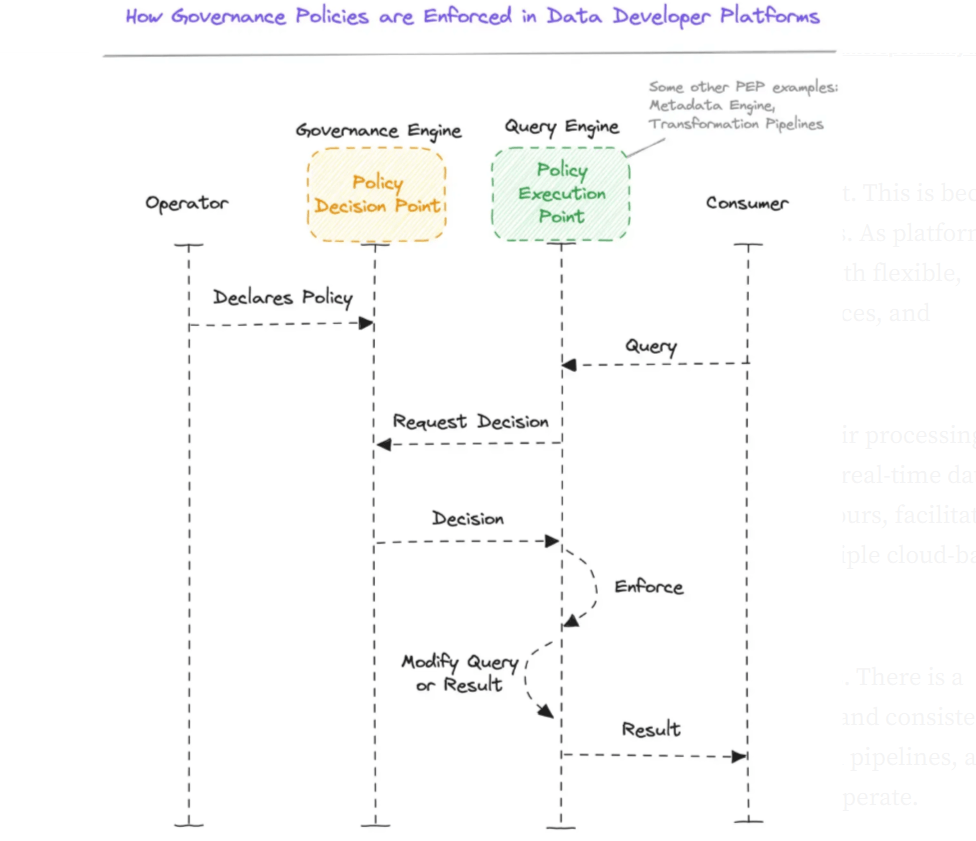
The core concept of ethical data governance is respecting individual rights and privacy in all data-related activities. At the same time, it also includes implementing practices that offer informed consent, strict access controls, and data anonymization, among others.
Approaching governance with a data product mindset leads to operationalizing it, according to different scenarios. It leads to governance policies getting embedded into the design of the product itself. Data Developer Platforms (DDP) transform governance from a barrier into an enabler, ensuring that the BI insights are both actionable and compliant.
Cloud-Based Analytical Solutions
The future of data analytics is cloud-native; there is no two ways about it. This is because enterprises are shifting quickly towards cloud-based analytical tools. As platforms and tools hosted on the cloud, they provide organizations with flexible, scalable, and real-time access to data, computational resources, and analytical tools.
They are also scalable, so businesses can easily tune their processing capacity and storage depending on their requirements. The real-time data helps in monitoring changing market dynamics and behaviors, facilitating better decision-making in the process. However, using multiple cloud-based solutions will create problems.
This is where data products chip in. There is a unifying data layer that ensures discoverability, portability, and consistency across different cloud platforms. There is no need to rebuild pipelines, as teams can use the same governed products whenever they operate.
Real‑Time and Streaming Analytics
Real‑time analytics refers to the ability to analyze data and generate insights with very low latency so that decisions can be made “in the moment” rather than after a delay.
For data analysts, this means working with streaming data pipelines, understanding windowed aggregations, and building dashboards that update in seconds, not hours. WhiteScholars data analyst course in Hyderabad program now includes hands‑on labs with streaming platforms and real‑time visualization tools like Power BI and Tableau, so learners can build skills that match industry demands.
Lakehouse and Data Mesh Architectures
Monolithic data warehouses are giving way to modern lakehouse architectures that combine the flexibility of data lakes with the performance and governance of data warehouses. Platforms like Databricks, Snowflake, and Microsoft Fabric are enabling organizations to store structured and unstructured data in one place while supporting advanced analytics and machine learning.
Alongside this, the data mesh concept, where data is treated as a product owned by business domains, is gaining traction. This requires analysts to understand data contracts, domain ownership, and federated governance. In a data analytics training in Hyderabad, these architectural trends are now covered through case studies and projects that simulate real enterprise environments.
Final Thoughts
The data analytics landscape in 2026 is defined by speed, intelligence, and governance. Real‑time analytics, GenAI, cloud platforms, and strong governance are no longer futuristic concepts, they are the new normal. the key to success lies in choosing the right data analytics training in Hyderabad that aligns with these trends and equips them with practical, job‑ready skills.
Whether you are just starting out or looking to upskill, now is the perfect time to enroll in a data analytics coaching in Hyderabad by WhiteScholars and position yourself at the forefront of the data revolution.
Frequently Asked Questions (FAQs)
1. What are the most important data analytics trends for 2026?
Key trends include real-time streaming analytics, generative AI for augmented insights, lakehouse architectures, decision intelligence, and data governance with provenance tracking. These shifts enable faster decisions, AI integration, and privacy-compliant operations across industries.
2. Why is real-time and streaming analytics becoming mainstream in 2026?
Real-time analytics processes data as it arrives, supporting instant fraud detection, dynamic pricing, and personalized experiences that batch processing cannot match. By 2026, IDC predicts 75% of enterprise data will be edge-processed, driving event-driven architectures like Kafka for continuous insights.
3. How is generative AI transforming data analytics?
Generative AI automates insight generation, natural language querying, and data engineering tasks, with 40% of analytics queries expected via plain English by 2026. It lowers barriers for non-experts while requiring strong data quality to avoid errors.
4. What role does data governance play in 2026 trends?
Governance ensures data provenance, quality, and compliance amid AI growth, tracking lineage to build trust and meet regulations. Poor data hinders 84% of AI strategies, making observability and synthetic data essential for reliable analytics.
5. How can professionals prepare for these 2026 trends?
Upskill in streaming tools (Kafka, Flink), cloud platforms (Snowflake, Databricks), and AI-assisted analytics through hands-on courses. Focus on real-world projects combining SQL, Python, and BI tools to meet demands in roles like data analyst.