
Top Career Choice in 2026 That AI Will Never Replace
This blog will explore the top career choice in 2026 that AI will never replace, specifically aimed at graduates and career shifters looking to start their journey today.
Irreplaceable Career in 2026
In this fast-changing world, every day thousands of jobs are getting replaced by AI, but there are fields which AI will never be able to replace even in the future. Let us now talk about one such field today ; it is not only a field that AI will never replace but also one of the most trending career fields of 2026.
And the most interesting part: anyone from any background can master this field from scratch through proper training and secure their future. The top career choice that every student must learn to build their future is digital marketing.
In fact, with the help of AI, digital marketing has become more integrated now. Let us know why digital marketing is trending in 2026. Why can’t AI ever replace it? What are the best resources to start learning digital marketing?
Why is Digital Marketing Trending?
Digital marketing is currently the dominant force in the industry because of several distinct advantages it holds over traditional marketing methods like TV, radio, newspapers, and billboards. These advantages include:
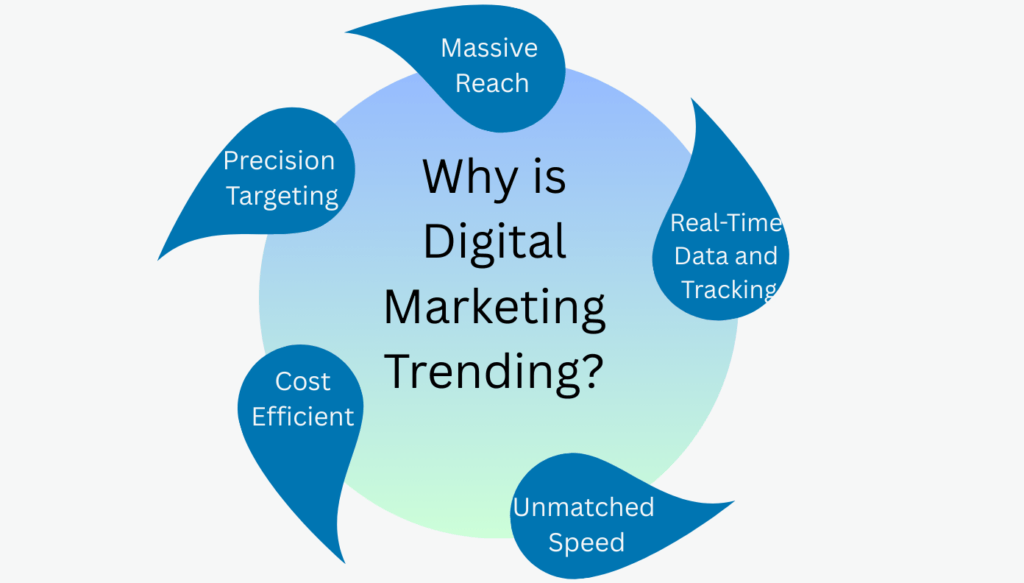
- Massive Reach: Digital tools allow a business to reach billions of people. Essentially, anyone with a laptop or a mobile phone is a potential customer.
- Precision Targeting: Unlike traditional media that often attempts to reach everyone, digital marketing allows for “handpicking the perfect crowd”. This precision ensures that marketing efforts are focused on the right people rather than a broad, uninterested audience.
- Cost-Effectiveness: Digital marketing is significantly cheaper than high-end traditional placements like a Super Bowl advertisement or a spot in the New York Times. In traditional marketing, you often pay a premium to reach a mass audience, many of whom are not your ideal customers.
- Unmatched Speed: Traditional campaigns take weeks or months to design, print, and distribute before results can be measured. Digital marketing allows for the launch of ads or posts in minutes, providing instant feedback.
- Real-Time Data and Tracking: Because digital marketing happens online, it leaves a “digital trail”. Marketers can track clicks, costs, and conversions in real time, allowing them to see exactly what is working and what needs to be tweaked.
Why AI Can Never Replace Digital Marketing
AI has changed marketing a lot, but it can’t completely take over digital marketing. Digital marketing is all about creativity, connecting with people emotionally, and being relevant to culture, things AI still finds hard. While algorithms are great at analysing data and predicting what consumers will do, they can’t think creatively, understand feelings, or tell stories that truly connect with people.
For instance, AI can generate ad copy or social media posts, but these often feel routine. Human marketers bring originality, humour, and cultural nuance that machines cannot replicate. A 2025 survey revealed that 72% of marketers believe creativity and emotional intelligence remain irreplaceable in campaign success. Moreover, brand identity is built on storytelling, something that requires human intuition and lived experience.
Another limitation is trust. Consumers are increasingly aware of AI‑generated content and may perceive it as impersonal. Digital marketing thrives on authenticity, and human strategists ensure campaigns align with brand values while adapting to cultural shifts. AI can suggest what works statistically, but it cannot anticipate societal trends or ethical considerations with the same sensitivity.
Finally, digital marketing is not just about execution; it’s about strategy. While AI can optimise ads in real time, it cannot set long-term brand vision. Human marketers integrate psychology, design, and market research into holistic strategies. This explains why over 80% of agencies now use AI as a tool, not a replacement.
In short, AI enhances digital marketing but cannot replace the human creativity, empathy, and strategic foresight that drive meaningful engagement. Digital marketing remains a human‑led field, with AI serving as a powerful assistant rather than a substitute.
How AI Integrates into Digital Marketing
Rather than replacing digital marketing, AI has become a powerful partner that integrates seamlessly into campaigns. Its strength lies in data analysis, personalisation, and automation, areas that amplify human creativity rather than diminish it.
One of the most impactful integrations is personalisation. AI algorithms analyse consumer behaviour across platforms, enabling brands to deliver tailored experiences. According to Statista, global revenues from AI in marketing are projected to reach $47 billion in 2026 and exceed $107 billion by 2028. This surge reflects how businesses are leveraging AI to personalise ads, emails, and product recommendations at scale.
AI also enhances efficiency. Tools powered by machine learning can automate repetitive tasks like A/B testing, keyword optimisation, and customer segmentation. This allows marketers to focus on creative strategy while AI handles the heavy lifting. Companies using AI‑driven marketing strategies report 37% higher conversion rates compared to traditional methods.
Another integration is predictive analytics. AI can forecast consumer trends and purchasing behaviour, helping marketers design proactive campaigns. For example, e‑commerce platforms use AI to predict which products customers are likely to buy next, ensuring timely promotions.
Content creation is another area where AI plays a role. While it cannot replace human creativity, AI tools assist in drafting blog posts, generating headlines, or suggesting visuals. This speeds up production while maintaining consistency.
Finally, AI integrates into customer service through chatbots and virtual assistants. These tools provide instant responses, improving customer satisfaction and freeing human agents to handle complex queries.
In essence, AI integrates into digital marketing as a scalable, data‑driven backbone that supports personalisation, automation, and predictive insights. It empowers marketers to deliver smarter campaigns, proving that the future of digital marketing is not man versus machine, but man working with machine.
Different Fields and Concepts of Digital Marketing
Digital marketing can be divided into several essential fields and strategic frameworks. To truly grasp the industry, it’s crucial to differentiate between strategy and tactics, along with the various domains where marketing takes place.
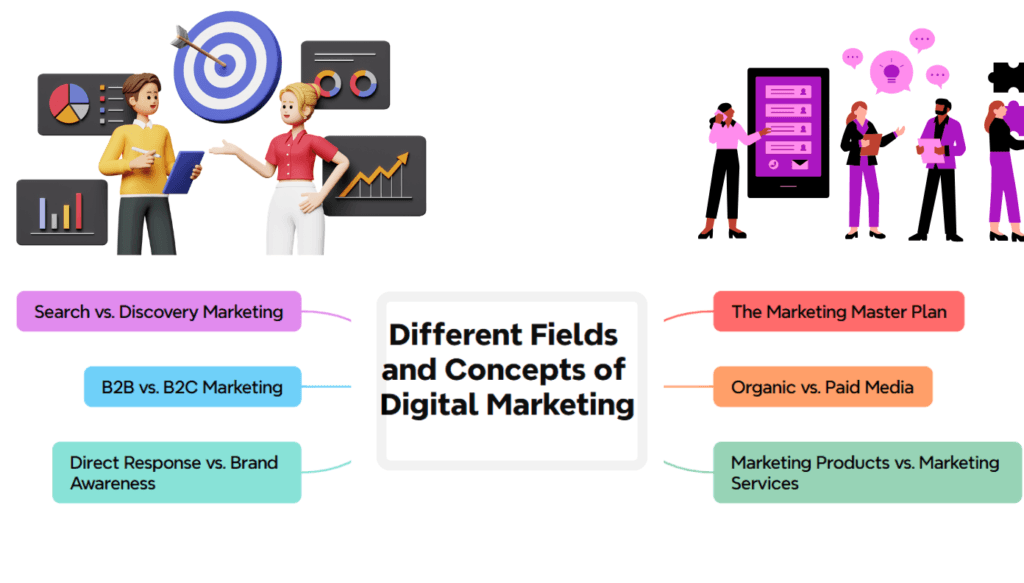
1. The Marketing Master Plan (The Five Parts of Strategy)
Marketers need to build a strong base before choosing a platform. In marketing, strategy is the big picture plan, while tactics are the specific steps to make that plan happen. You can think of strategy as picking the right place to fight and tactics as the ways to win. The “Marketing Master Plan” consists of five main parts:
- The Model: This refers to the business setup: what you sell, the price, and the delivery method. For long-term success, a business model must be profitable, enjoyable to run, and offer something the market actually wants based on research.
- The Market: Identifying the “ideal customer avatar” is critical. This involves three categories of detail:
- Demographics: age, gender, income, and occupation.
- Geographics: The specific location (city, state, or country) where the audience lives.
- Psychographics: The most important category, involving the audience’s values, attitudes, beliefs, and lifestyles. The goal is to describe the audience better than they can describe themselves.
- The Message: This involves speaking the language of the target market. Effective messaging talks directly to their struggles and uses stories or testimonials to show how the business provides a solution. Customers don’t buy when they understand; they buy when they feel understood.
- The Media: Only after the model, market, and message are established should a marketer choose their channels. These include YouTube, email, Instagram, and podcasting. A common mistake is choosing a media platform first (the “media first” mistake), which often leads to wasting time and money on platforms where the ideal customer isn’t active.
- The Machine: This is the marketing funnel, a repeatable system that turns strangers into loyal customers.
A typical online funnel includes traffic (from social media or ads), an opt-in page (to collect emails), an email follow-up series (to build relationships), and a conversion tool (like a sales call or checkout page). The “machine” makes growth predictable and scalable, acting like a “vending machine” where attention is put in and sales come out.
2. Organic vs. Paid Media
These are the two primary ways to distribute content and attract an audience.
- Organic Marketing: This includes any content posted without paying for promotion, such as YouTube videos, Instagram stories, blog posts, and emails. It is “free” in terms of ad spend but requires a heavy investment of time and energy. Organic marketing is best for building depth and trust, though it is often slow.
- Paid Marketing: This involves spending money on platforms like Facebook, Instagram, YouTube, or Google Ads to get content in front of more people. Paid marketing is powerful for speed and scale. Most businesses should start with organic to prove their message and then use paid marketing to scale what works.
3. Direct Response vs. Brand Awareness
These represent different goals and measurement styles in marketing.
- Direct Response Marketing: This focuses on getting an immediate action from the audience, such as “Buy now”, “Click here”, or “Sign up”. It is fast, measurable, and focused on return on investment (ROI).
- Brand Awareness Marketing: This is a “long game” focused on building trust, credibility, and recognition. It is harder to measure because you don’t get a notification when someone starts to trust your brand. Be cautious of falling into the “trap” of expecting direct-response results from brand awareness campaigns. For most businesses, the focus should be roughly 90% on direct response marketing.
4. Search vs. Discovery Marketing
The difference between these two fields comes down to intent.
- Search Marketing: This takes place on engines like Google or YouTube (when used for searching). People on these platforms have a specific mission; they are looking for an answer or a product. This is “high intent” marketing, where the marketer’s job is to show up and solve the problem through SEO or paid search ads.
- Discovery Marketing: This occurs in the “social scroll zone” on platforms like Instagram, TikTok, or Facebook. Users are not searching; they are “killing time” or “chilling out”. The marketer’s job here is to stop the scroll by being entertaining, intriguing, or educational to earn the user’s attention.
5. Marketing Products vs. Marketing Services
The strategy changes depending on whether the offering is tangible or intangible.
- Product Marketing: Products can be unboxed, touched, and demonstrated. Marketers can highlight physical features and perks (e.g., the safety features of a pen lid).
- Service Marketing: Services are invisible and cannot be tried before purchase. Therefore, marketers should not sell the service itself but the transformation. This involves highlighting the “pain” the client is currently in and painting a picture of the “irresistible” life they will have after the service is completed.
6. B2B vs. B2C Marketing
Finally, the approach varies based on the type of customer.
- B2B (Business-to-Business): This involves selling to companies and organisations. It typically features fewer customers, bigger deals, longer sales cycles, and multiple decision-makers. B2B marketing relies on logic-heavy pitches focused on ROI and outcomes; these buyers want to feel smart and safe.
- B2C (Business-to-Consumer): This involves selling directly to individuals. It features simpler, faster buying decisions and emotion-driven messaging focused on desire, identity, and lifestyle. B2C buyers want to feel seen and excited.
By mastering these fields, from the strategic foundation of the master plan to the execution of direct response tactics on search or discovery platforms, marketers can build repeatable systems that generate revenue on autopilot.
Best resources to learn digital marketing
Do you know that a fresher in digital marketing in India can earn anywhere between ₹2.5 and ₹5 lakhs per annum, depending on their skills and the city they work in? With just 3 to 5 years of experience, salaries often double or even triple, reaching ₹8 to 12 lakhs per annum.
And for senior professionals or managers, the numbers can go as high as ₹20 to 40 lakhs annually, especially in high‑growth roles like performance marketing, AI‑driven campaigns, and data analytics.
To achieve this, it is essential to effectively manage real-time data and resources. For that purpose, you will require a well-structured training program. One excellent option is the White Scholars Digital Marketing Course, which is powered by artificial intelligence.
This course is designed not only to enhance your technical skills but also to develop your soft skills. It includes a variety of activities aimed at improving your communication abilities, ensuring that you are well-equipped to navigate the complexities of digital marketing in today’s fast-paced environment.
The training is offered in both online and in-person formats, with experienced mentors available to help students learn quickly.
Final Thoughts
Digital marketing is a powerful tool for modern businesses, offering unmatched reach, precision, and speed compared to traditional methods. Success requires a “marketing master plan”, focusing on strategy (model, market, message, media, and machine) before choosing specific tactics.
While organic marketing builds depth, paid marketing provides scale. Most businesses should prioritise direct response marketing to drive immediate ROI while tailoring their approach based on whether they are selling products or services and whether they are targeting search or discovery intent.
Ultimately, mastering these fundamentals ensures repeatable and scalable growth.
Frequently asked questions
1. What is the difference between marketing strategy and tactics?
Strategy is the overall plan or battlefield you choose to fight on, while tactics are the micro-moves or actions used to execute that plan. Using tactics without a solid strategy is just “noise” that often leads to no results.
2. Why is “direct response” marketing prioritised for most businesses?
It focuses on getting an immediate action (like a sale or sign-up) that is fast, measurable, and ROI-focused. Unlike brand awareness, it allows you to track clicks and conversions in real time to see exactly what works.
3. What is the “Media First” mistake?
This is picking a platform like Instagram or YouTube before defining your business model, target market, and core message. Starting with media leads to “shiny object syndrome” and often wastes money on platforms where your ideal customers aren’t even active.
4. How do you market a service effectively if it is intangible?
Instead of selling the service itself, you must sell the transformation, the difference between the client’s life “before” and “after” your help. You should highlight their current pain and paint an irresistible picture of the results and feelings they will achieve.
5. How does search marketing differ from discovery marketing?
Search marketing targets users with high intent who are actively looking for answers or products on engines like Google. Discovery marketing focuses on interrupting the scroll on social media to earn attention from people who are just “killing time”.