

Top SQL Queries Asked in Data Analyst Interviews at Microsoft
Introduction
In today’s data-driven world, companies use data to make smarter decisions, creating a growing demand for skilled Data Analysts.
For fresh graduates, SQL is a must-have skill as it helps analysts extract, analyze, and transform data from databases. Top companies like Google, Amazon, Microsoft, Accenture, and Deloitte test SQL skills during Data Analyst interviews.
In this blog, we will explore commonly asked SQL queries and learn simple ways to solve interview problems with confidence.
Why SQL is Important for Data Analyst Interviews in 2026
SQL continues to be one of the most important skills for Data Analysts in 2026. As businesses generate massive amounts of data, SQL helps analysts transform raw information into meaningful insights that support better decision-making.
A Data Analyst uses SQL to:
- Extract data from databases
- Clean and transform information
- Identify trends and patterns
- Create business reports
- Solve real-world business problems
During interviews, recruiters test SQL skills to understand a candidate’s ability to work with data, analyze information, and solve practical challenges.
For fresh graduates, strong SQL knowledge can create a major advantage in the job market. By practicing commonly asked SQL queries and real-world scenarios, candidates can improve their confidence and become better prepared for Data Analyst interviews.
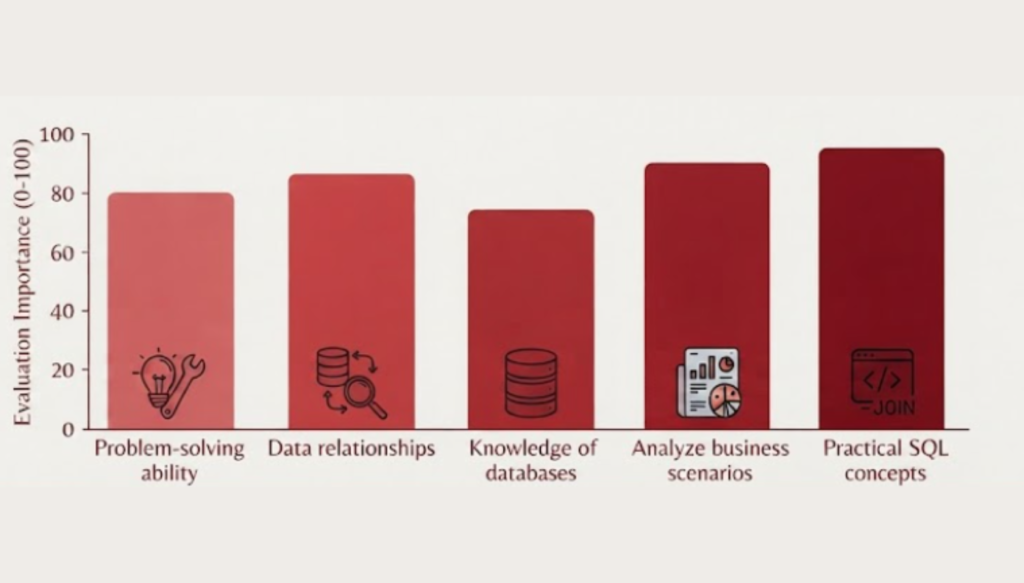
Why Top Companies Test SQL Skills
Top SQL Queries Asked in Data Analyst Interviews
| Commonly Asked SQL Problem | Business Scenario | Key SQL Concepts & Functions |
| 1. Finding Duplicate Records | Identify repeated data entries. | GROUP BY, COUNT(), HAVING |
| 2. Finding the Second Highest Salary | Test logic for N-th value retrieval. | Subqueries, MAX(), Ranking Logic |
| 3. Finding Top N Records | Used for ranking problems | ORDER BY, LIMIT, Window Functions |
| 4. Finding Above-Average Performers | Analyze employees or products against the mean. | AVG(), Subqueries |
| 5. Finding Customers Without Orders | Practice database relationships. | LEFT JOIN, NULL Handling |
| 6. Calculating Sales Insights | Analyze business performance over time | SUM(), GROUP BY, Date Functions |
| 7. Ranking Employees or Products | Master precise ranking techniques. | ROW_NUMBER(), RANK(), DENSE_RANK() |
| 8. Calculating Running Totals | Understand cumulative trends. | Window Functions, OVER() |
| 9. Applying Business Logic | Use conditional logic for segmentation/analysis. | CASE WHEN, Customer segmentation, Performance analysis, Data classification |
SQL Interview Tips for Fresh Graduates
SQL interviews are not about memorizing queries they are about understanding logic and solving problems.
Keep these tips in mind:
- Understand the Question: Know what data the interviewer needs before writing a query.
- Practice Real Data: Work with datasets like sales, customers, and finance.
- Learn Multiple Methods: Explore different ways to solve the same problem.
- Explain Your Logic: Interviewers value your approach, not just the final answer.
Strong SQL skills come from practice, not memorization.
How to Write SQL Queries Easily
Many students find SQL challenging because they focus on memorizing commands instead of understanding the logic behind them. The easiest way to write SQL queries is to first understand the problem, identify the required data, and break the solution into smaller steps. Start by selecting the right data, apply necessary filters, perform calculations, and organize the final results. With regular practice and a clear problem-solving approach, writing SQL queries becomes much simpler. Remember, mastering SQL is not about memorizing hundreds of queries it is about learning how to think with data.
Common SQL Mistakes to Avoid
Fresh graduates often make these mistakes during interviews:
- Confusing WHERE and HAVING
- Forgetting GROUP BY
- Using incorrect JOIN conditions
- Ignoring NULL values
- Writing unnecessary complex queries
- Not understanding the output before writing the query
- Memorizing queries without understanding the logic
Avoiding these mistakes can significantly improve SQL interview performance.
SQL Course in Hyderabad at WhiteScholars
For fresh graduates who want to build a career in Data Analytics, learning SQL with practical industry exposure can create better career opportunities.
The SQL course at WhiteScholars focuses on helping students understand database concepts, write efficient queries, and apply SQL skills to real-world business scenarios.
Through practical learning, students can develop the confidence required for Data Analyst roles and technical interviews.
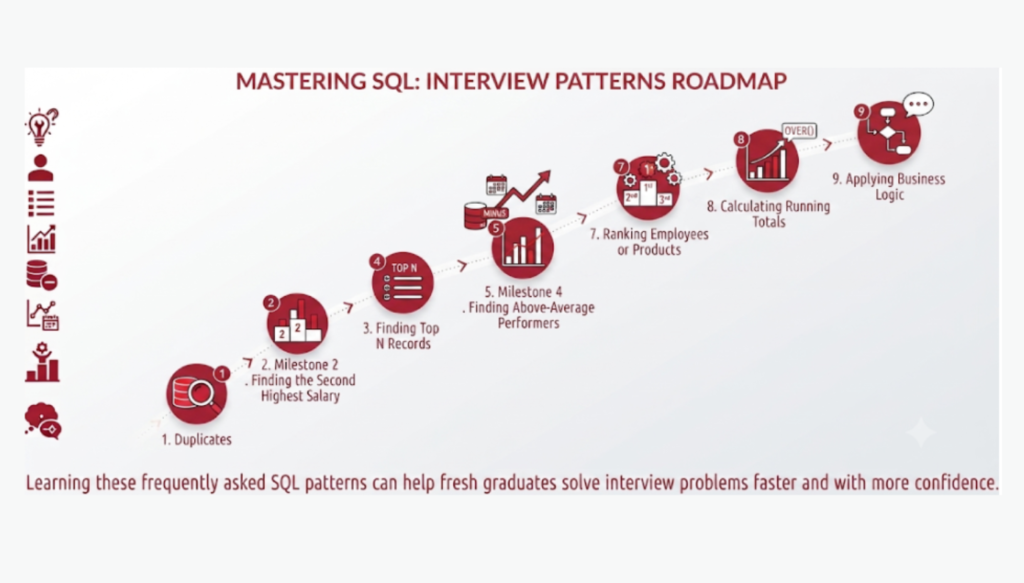
SQL Learning Roadmap
How WhiteScholars Helps Fresh Graduates
WhiteScholars focuses on bridging the gap between academic learning and industry requirements.
Students get:
- Practical project-based learning
- Industry-oriented curriculum
- Hands-on SQL practice
- Interview preparation support
- Guidance from experienced mentors
The goal is to help fresh graduates develop job-ready skills and confidently enter the analytics industry.
A Message from WhiteScholars
Hey, we are Team WhiteScholars.
Thank you for taking the time to read this blog. Our mission is to help learners develop practical skills and understand technologies that are shaping today’s job market.
We believe learning becomes more valuable when combined with real-world practice and continuous improvement.
Keep learning, keep building, and keep growing with WhiteScholars.
FAQ’s
1. Is SQL important for Data Analyst jobs in 2026?
Yes, SQL remains one of the most important skills for Data Analysts because professionals use it to extract and analyze data from databases.
2. What SQL topics should fresh graduates prepare for interviews?
Fresh graduates should focus on SELECT, WHERE, JOINs, GROUP BY, Subqueries, Window Functions, and CTEs.
3. How long does it take to learn SQL for Data Analyst interviews?
With consistent practice, beginners can build a strong SQL foundation within a few weeks.
4. Do Data Analysts need advanced SQL knowledge?
Yes, understanding advanced concepts like Window Functions and query optimization helps analysts solve complex business problems.
5. Can SQL alone get me a Data Analyst job?
SQL is an important skill, but combining it with Excel, Python, visualization tools, and business understanding creates a stronger Data Analyst profile.
