

AI and Automation in the Digital Marketing Workforce
Let’s discover how AI and automation are transforming digital marketing roles, boosting productivity, and introducing new skill sets in 2026.
Defining AI in Digital Marketing
‘Artificial intelligence’ (AI) in digital marketing refers to software that is capable of learning from data and making decisions regarding tasks that previously required human input.
This technology is no longer a future idea but an active environment where marketers currently operate.
Common uses of AI include recommendation engines on platforms like Netflix, search result optimisation on Google, and personalised email marketing that addresses customers by name or suggests products based on browsing history. These capabilities are often designed and implemented by an experienced AI development company to help businesses deliver smarter, data-driven user experiences.
AI serves as an advanced assistant that analyses customer reviews, campaign results, and visitor behaviour to allow for faster, more informed decision-making.
It is rarely a standalone product; rather, it is a capability integrated into existing tools such as email platforms, ad managers, website analytics, and social media schedulers.
The primary role of AI is to analyse data, predict behaviour, automate tasks, and improve overall campaign performance. Let’s learn more about this in this blog.
The Fundamental Shift in Industry Scope
The current era represents a change from previous digital milestones like the rise of social media or mobile technology.
While those shifts required brands to master new channels or optimise for different screens, AI acts as a new operating layer across all channels simultaneously.
It influences content creation, audience segmentation, campaign measurement, and high-level decision-making. This shift requires a review of the daily responsibilities of marketing professionals.
Historical Comparison: Manual vs. AI-Driven Eras
Digital marketing was a manual process. It was slow, expensive, and often based on “gut-feeling” decisions. Writing content, testing email subject lines, and building audience segments in spreadsheets took significant time. The shift occurred around 2022-2023, when AI tools became sufficiently fast, affordable, and intelligent for mainstream marketing teams.
The introduction of large language models like ChatGPT enabled the instantaneous generation of blog drafts, ad headlines, and customer emails.
Statistics indicate that 63% of marketers now utilise AI tools weekly, content production is five times faster, and roughly 40% of repetitive tasks are automated, saving the average professional approximately three hours a day.
Unlike past technological changes, this transformation is now happening simultaneously across all channels: SEO, email, social media, and paid ads.
The Impact on Human Roles and Productivity
AI is not replacing digital marketers but is fundamentally changing how they allocate their time. The technology handles technical execution, such as keyword research or first-draft generation, in seconds.
Consequently, the human role is transitioning toward reviewing, refining, and adding original insights to ensure content remains human-centric and aligned with brand identity.
Roles focused on repetitive, manual execution, such as basic post-scheduling or running standard performance reports, are shrinking.
Conversely, roles requiring judgement, creativity, strategy, and relationship-building are expanding. This shift is described as a “calculator moment” for the industry; just as calculators shifted accountants from arithmetic to strategic advisory, AI shifts marketers from manual tasks to high-level decision-making.
Essential Skills for the AI Era
To remain valuable in an AI-driven environment, professionals must develop specific, learnable skills that emphasise strategic judgement over technical execution.
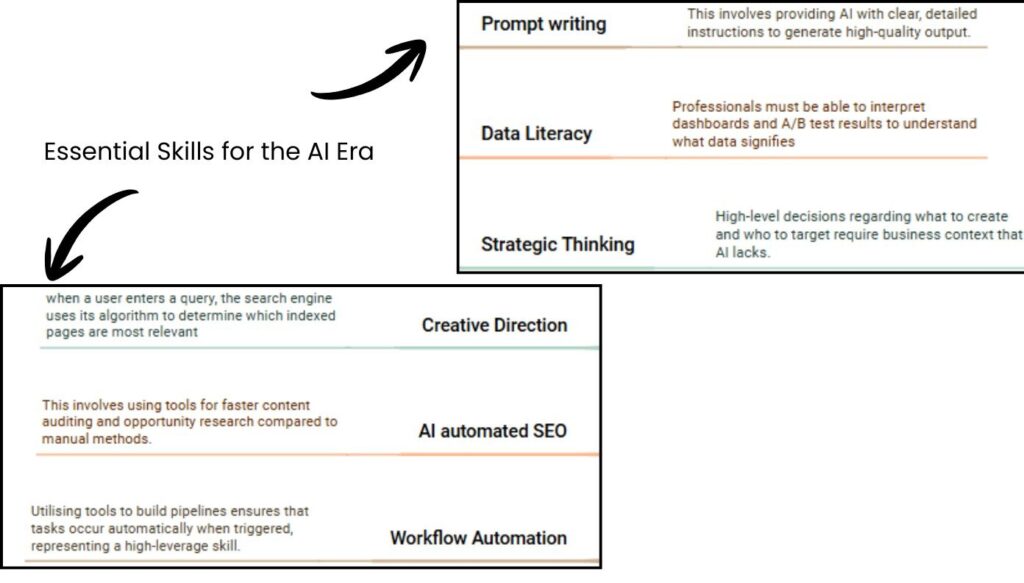
- Prompt Writing: This involves providing AI with clear, detailed instructions to generate high-quality output. A well-structured prompt includes context, tone, and specific goals to avoid generic results.
- Data Literacy: Professionals must be able to interpret dashboards and A/B test results to understand what data signifies, rather than simply reporting numbers.
- Strategic Thinking: High-level decisions regarding what to create and who to target require business context that AI lacks.
- Workflow Automation: Utilising tools to build pipelines ensures that tasks occur automatically when triggered, representing a high-leverage skill.
- Creative Direction: Humans must guide AI to produce output that matches a brand’s specific emotional tone and visual identity.
- AI-Assisted SEO: This involves using tools for faster content auditing and opportunity research compared to manual methods.
Strategic Tool Analysis
Several tools have become essential for modern marketing teams, each serving specific functional purposes:
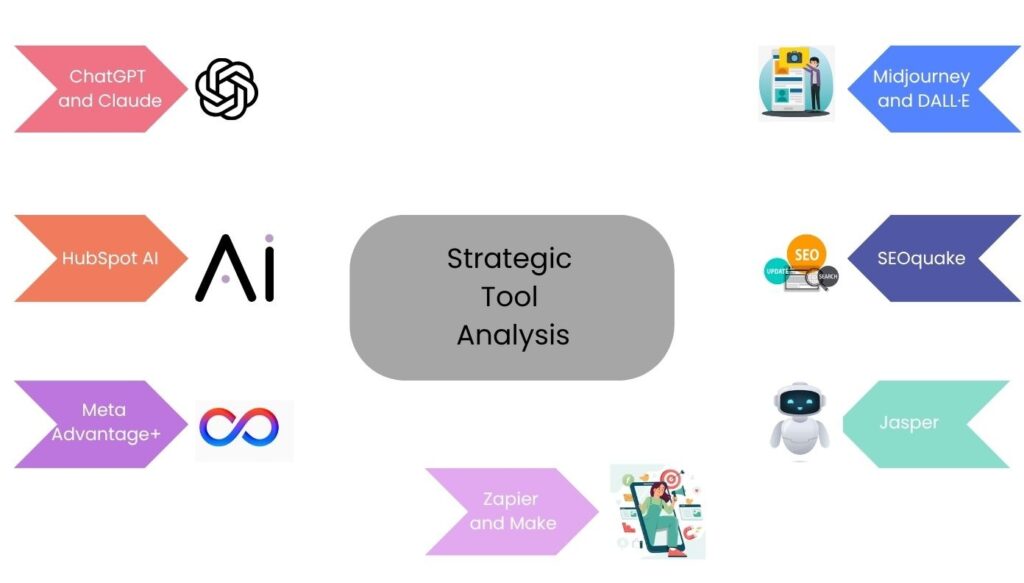
- ChatGPT and Claude: General-purpose assistants used for drafting blog posts, ad copy, and email sequences, saving approximately five hours per week for content teams.
- Jasper: A marketing-specific writing tool that learns and maintains a consistent brand voice across various clients and content types.
- SEOquake: This tool analyses top-ranking pages to provide briefs on topics and keywords, reducing a day’s work to ten minutes.
- HubSpot AI: Integrated into CRM systems, it scores leads, drafts follow-ups, and suggests optimal contact times, saving roughly six hours per week.
- Midjourney and DALL·E: These tools generate professional-quality images, social media graphics, and ad visuals from text descriptions.
- Zapier and Make: These platforms connect disparate marketing tools to automate workflows, such as automatically sending follow-up emails after a form submission.
- Meta Advantage+ and Google Performance Max: AI-driven platforms that automatically test ad variations and audiences, saving an average of seven hours per campaign.
Learn to explore all these strategic tools in the best digital marketing classes in Hyderabad, powered by AI from WhiteScholars.
Efficiency and Time Management Metrics
When used effectively, AI provides significant time savings across various marketing tasks.
- Blog Production: Writing a 1,000-word post once took 3-4 hours; AI reduces this to roughly 20 minutes for a draft and 40 minutes for editing, saving 2.5 hours.
- Email Marketing: Generating ten high-quality subject line variations takes under 60 seconds with AI, saving nearly an hour per campaign.
- SEO Research: Building a content brief is reduced from 3-5 hours to approximately 10 minutes, saving half a working day.
- Performance Reporting: Automating data collection and summarisation reduces a 6-hour task to 45 minutes of strategic notation.
- Content Repurposing: Converting a blog post into multiple social media formats is reduced from 90 minutes to 3 minutes.
Collectively, an AI-enabled marketer can reclaim 10 to 15 hours every week to focus on brand growth.
The Future of Marketing Job Roles
The job market is evolving to include entirely new career paths while modifying existing ones.
- Evolving Roles: Content writers are becoming editors and directors of AI output. Social media managers are shifting toward performance analysis and creative strategy. SEO specialists are focusing on technical site architecture rather than manual keyword research.
- Growing Roles: New positions include AI marketing strategists, who deploy AI stacks; automation workflow designers, who build system connections; and prompt specialists, who craft instructions for optimal AI output.
By 2027, proficiency in AI tools is expected to be a standard requirement in marketing job descriptions, similar to Excel or Google Analytics. The combination of human judgement, creativity, and confident tool usage defines the future professional.
Industry Benefits and Implementation
AI improves return on investment (ROI) by analysing data in real time to identify high-performing campaigns and optimising advertising spend to reduce waste. It enhances customer personalisation by analysing browsing behaviour and preferences to deliver targeted recommendations that increase conversion rates.
Implementation Strategies for Businesses: Businesses can adopt AI by integrating automation platforms, using AI-driven analytics, deploying chatbots for customer service, and automating email or ad campaigns.
Small businesses can also leverage these tools to compete with larger companies by automating tasks and improving targeting at an affordable cost. Industries that rely heavily on customer data, such as e-commerce, real estate, healthcare, finance, education, and SaaS, benefit most from these advancements.
The transition to an AI-driven workflow can begin with small experiments, such as using AI for a single blog brief or one automation task, to build the necessary fluency for long-term success. Professionals who adopt these tools often find their roles becoming more senior and strategically focused.
Overall, automation reduces manual workload, allowing teams to focus on brand building and creative planning.
Conclusion
The integration of AI into digital marketing represents a fundamental shift from manual execution to strategic oversight. By automating repetitive tasks, professionals can reclaim significant time to focus on high-value creative and analytical work.
Success in this evolving landscape depends on the synergy between human judgement and advanced technical tools. As AI becomes a standard industry requirement, building proficiency in these technologies is essential for long-term career growth.
The future belongs to those who view AI as an upgrade rather than a replacement for human expertise.
Frequently Asked Questions
1. What is AI in digital marketing?
AI refers to technologies that analyse data, predict behaviour, and automate tasks to improve campaign performance. It enables faster decision-making and the creation of highly personalised marketing strategies for businesses.
2. Will AI replace digital marketing jobs?
AI is unlikely to replace jobs entirely but is instead changing roles and creating new career opportunities. Professionals who master AI and automation platforms will likely see better career prospects in the evolving industry.
3. What are the primary benefits of using AI?
The main advantages include faster campaign management, better customer targeting, and improved return on investment. Automation also significantly reduces manual workloads, allowing teams to focus on strategy and brand building.
4. What skills are essential for the age of AI?
Marketers should focus on data analysis, interpretation, and the strategic use of automation platforms. Combining these technical skills with content strategy and storytelling is vital for maintaining a competitive edge.
5. How can businesses begin implementing AI?
Implementation can start with adopting marketing automation platforms and integrating AI analytics tools into existing workflows. Small experiments, such as using chatbots or automating email campaigns, help businesses gradually adopt these technologies.
