

5 Mistakes Fresh Graduates Make When Applying for Data Jobs and How to Avoid Them

Finding a data-related role and the right job for fresh graduates in such a competitive world will be challenging, very exciting and a little bit frustrating too.
Most of the fresh graduates make common mistakes that prevent them from getting a job. There are mistakes that are most commonly made by many graduates, and that can definitely be avoided.
The uncomfortable truth is that it is rarely about your raw intelligence. It is all about presenting your skills, projects and showcasing yourself as the best fit for the role. Most graduates make the same five mistakes while applying for data-related jobs. But each one is fixable with a small shift in the approach.
Sending a Generic Resume
The first and foremost mistake any fresh graduate makes is creating a generic resume, meaning having only one resume to apply to any data-related job. This happens most of the time because of a lack of understanding of HR screening resumes in the selection process.
Every job has its own uniqueness, even though the title of the jobs looks similar. A fintech company has different expectations from an e-commerce company for the data analyst role they are hiring.
Companies mostly use the ATS (Applicant Tracking System) for the screening process. In it, each and every resume submitted for the job will go through an automated screening for matching the job title and key job skills with those you have written in your resume, and it gives it a score. The higher the score, the higher the chances of getting selected in screening.
This is the main reason why one should apply with a customised resume; moreover, one should be prepared to match the job skills and job title.
How to Avoid This
- Create one all-inclusive resume, which can be called as core resume / base resume
- Customise this for each and every application based on the role and skills given in the job description.
- Be honest about the skills you are mentioning in your resume
- Highlight the projects you did in your academics or any internship.
- Create the details, like what and how you did, what the insights and recommendations you provided are, in a verb format like analysed, visualised, reported and summarised.
- Keep it simple English, don’t use complicated words
- Don’t forget to make it ATS-friendly, and before applying, check your resume with ChatGPT or any AI source and ask it to give a score.
Applying for data role jobs
Two types of mistakes that fresh graduates make, which create a problem while applying for any job.
They apply too much or in bulk without a second thought, and the next one is to search only for one particular keyword and apply only for the jobs they get on the results page.
Freshers generally feel that applying in bulk is a great strategy at the beginning since it consumes little time and is also very easy to select all and apply for all. Different roles require different sets of skills as essential or basic. So, one resume is not sufficient for applying to every role.
Even when applying, one needs to analyse the job roles and skill set given for the job role and description in the ad and customise the resume and apply it accordingly.
Applying in bulk will only make you apply for jobs and will create more dissatisfaction since you feel you applied for 50 or 100 jobs, but you didn’t get shortlisted anywhere. Try to avoid getting into this totally.
Here, get assistance from WhiteScholars Academy not only for placement assistance. Where, they will be guided to avoid all mistakes generally freshers make which is inclusive of data analyst training in Hyderabad.
How to Avoid This
- Don’t apply in bulk with a generic resume.
- Try to go through the job description and skills
- Try to reach out to the company’s website to get info on what their ongoing projects are.
- Keep a schedule and spend some dedicated time applying for jobs.
- Chances of getting selected increase as you customize your resume.
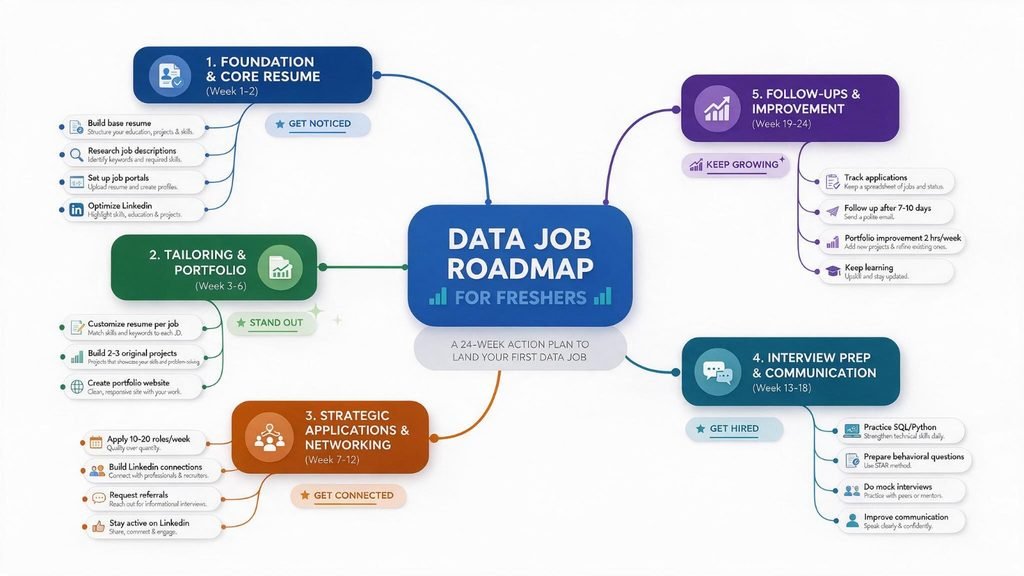
Mentioning the details of tools and projects
Every data analyst, data scientist or any data-related role job aspirant will be doing a project to showcase their technical skills. The mistake fresh graduates make here is showing up with an old built-in project or some tutorial projects shown on YouTube or any social media.
Sometimes the resume appears more like a course list with a number of tools acquired during your education or during your internship, only with some basic knowledge of that tool. Just doing online certifications and courses, but not doing any relevant projects, is a big mistake.
Learning a skill and demonstrating it are two different things. So, project every skill you have in the best possible manner. Generally, it is not a lack of skill, but it is all about how you demonstrate it.
Internships, academic projects, freelance work, hackathons, case studies, and even well-documented personal projects can all count as experience if presented properly.
A resume that only lists tools and technologies without any context reads like a grocery list.
How to Avoid This
- Instead of mentioning “Worked on data analytics project”, you can provide a brief of how the data is taken or extracted, how you worked on it, and what the results are.
- Post your Project on LinkedIn, details such as dashboards you created, analysed trends, and inferences or recommendations you have taken from the project.
- You can even try to create a portfolio of yours, which will show details of your projects, methods you applied to do them, and your academic and career goals and interests.
- Describe the project with some metrics in it; numbers always give you more advantage while presenting.
- Try to catch up with the latest trending business issues and provide your own solutions to them in your projects.
Depending only on job portals
Job seekers always try to go with only one job search portal, which is their favourite. This becomes a huge mistake in finding a job in this competitive market.
A mix of sources to gather information on vacancies is critical in landing a dream job.
All Job portals should be browsed to find out about any recent vacancies. Searching for company websites for any vacancies for data analyst-related roles on their career pages. Try to attend all college placement drives. Get testimonials from your favourite teachers or mentors. Some get placed with the help of alumni and referrals only. So, always stay within the reach of your network.
Points to be kept in mind while job searching are
1. What job are they searching for – Relevant job applications
2. Location of job
3. Try to know job by reading job description
4. Did your job skills and skills match you or not?
5. Is the job posted recently or a long time ago?
How to Avoid This
Need to be methodical and also strategically conscious while searching for a job.
1. Relevant job application – 10-20 /week
2. Building quality LinkedIn connections – 5-15 /week
3. Referral request – 2-5 /week
4. Stay active on LinkedIn by commenting or engaging with posts – minimum 2 /week
5. Portfolio Improvement – 2 hrs/week
Focusing only on Technical Skills
For any candidate looking for a data analytics and data science jobs, they primarily think that they will get hired for their technical skills alone. But, an essential skill that helps you in creating a great career is communication skills, which generally freshers ignore. This becomes a key differentiator when HR chooses the candidate for any job role.
Communication skills are entirely about the personality of a job seeker, how he presents himself in the interview and in the long run, how he handles his performance in his job.
This needs to be nurtured, or this skill only comes with consistent practice.
WhiteScholars Academy not only trains you for data science course in Hyderabad but also make them put it to use also guide to showcase the output properly.
How to Avoid This
1. Practice explaining technical concepts in simple words.
2. Improve your presentation skills to communicate insights effectively.
3. Prepare for HR and behavioural questions alongside technical interviews.
4. Participate in mock interviews and group discussions.
5. Practice speaking regularly to build confidence and clarity.
Conclusion
Applying for jobs in a proper manner saves a lot of precious energy. The significant thing is not to run behind certifications only, without upgrading the skills. The skills you gathered shall also be showcased in the right format and in the right places. Not depending on only one job portal is key to not missing out on any other vacancies posted. Last but not least, focus on communication skills, as it is a prime factor when it comes to delivering the results of what you have done in your projects. This will help you in the long run, even in career development.
What matters is whether you can demonstrate that you have the skills, practical experience and problem-solving mindset needed for the role.
Breaking into data analytics roles requires more than just technical skills. It requires positioning yourself as someone who can turn data into decisions.
FAQ’s
1. What should a fresher include in a data analyst or data science resume?
A fresher should highlight relevant technical skills, academic or internship projects, certifications where relevant, practical experience, and measurable project outcomes.
2. How many resumes should freshers create when applying for jobs?
Prepare one core resume with all your skills and certifications and customize the resume for every application based on the job description.
3. Are academic projects useful when applying for data-related jobs?
Yes, absolutely, but one has to showcase it in a particular way so that it is highlighted properly.
4. Why are communication skills important for freshers applying for data jobs?
Data professionals need to explain technical concepts, findings, and recommendations clearly. Strong communication helps candidates perform better in interviews and eventually communicate data-driven insights effectively in the workplace.
5. How can fresh graduates increase their chances of getting a data job?
Fresh graduates can improve their chances by building practical projects, creating an ATS-friendly and customized resume, developing a portfolio, applying strategically, networking on LinkedIn, seeking referrals, and regularly practicing technical, behavioural, and communication skills.
