

Can a Non-IT Graduate Become a Data Analyst / Data Scientist
Introduction
Are you trying, as a non-IT graduate, to become a data analyst/data scientist in Hyderabad & looking for a career with strong growth opportunities? You don’t need a computer science degree to start a career.
Anyone, even without an IT degree, can a Non-IT graduate become a data analyst / data scientist. In fact, one’s degree isn’t a factor that decides whether or not they can build a career in data analytics. A computer science degree is not a necessity if you want to start a career in data analytics; employers tend to place greater importance on your practical skills, your ability to solve problems, the portfolio you have, and your communication skills more than the specific degree you hold.
If you have just graduated and are asking yourself, “I never studied IT. Can I still end up as a data analyst?” The answer is yes provided that you acquire the appropriate skills and are able to show that you can apply them to real-world situations. For someone who has just finished their degree and is encountering a tough job market, a career in data analytics is a realistic option even if you don’t have a degree in computer science or in IT.
Nowadays, employers tend to assess candidates according to their practical abilities, that is, whether or not they can locate data, clean it, analyze it, and explain what it means for the business.
A large number of people who have studied commerce, management, the arts, science, engineering, mathematics, economics, and other subjects not involving IT are now looking at careers related to data, as businesses across all industries are becoming increasingly dependent on data when making decisions. A data analyst is not merely a technical kind of worker; the job also demands curiosity, an understanding of business, and good communication skills.
Use Your Degree as an Advantage
Your degree can help you in choosing careers in the field of data where specific subject knowledge is important; for example, those with qualifications in commerce and finance could go into financial analytics, banking, or FP&A, while graduates in biology and healthcare could look at healthcare analytics or clinical data positions.
People with degrees in marketing and psychology could pursue customer, product, or marketing analytics, and non-computer-science engineering graduates might consider operations, supply chain, and manufacturing analytics.
The most suitable candidates have both the ability for analysis and a practical understanding of the business problem, and the degree you have provides some relevant context for your analysis.
Don’t Let “Non-IT” Become a Limitation
A major error made by new graduates is to reject themselves prior to applying.
You could reason to yourself, “Since I come from the field of commerce, companies won’t employ me,” or “As I studied the arts, data analytics isn’t suitable for me.”
What you should do instead is concentrate on what you are able to build.
Your degree forms part of your background, while your skills, the projects you have undertaken, your problem-solving capabilities, and your ability to communicate insights are things that you can actively develop.
It’s not necessary for you to become an expert all at once. Just begin with one tool, put together one project, and resolve one business problem before carrying out the process again.
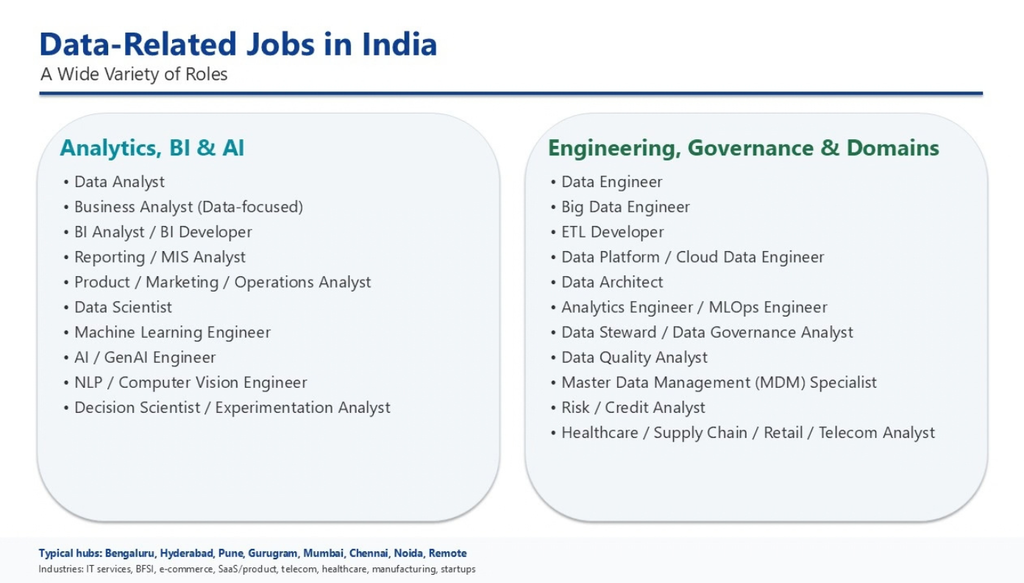
What Data-Related Jobs Can You Target?
The exact requirements vary between employers, so read job descriptions carefully and identify the skills that appear repeatedly.
A non-IT graduate interested in analytics can explore several entry-level roles, including junior data analyst, data analyst intern, business analyst intern, reporting analyst, MIS analyst, operations analyst, marketing analyst, financial data analyst, and business intelligence analyst.
Entry-level and support roles
Good starting points if you’re new to data.
- Data Analyst Intern / Trainee – Assist with data cleaning, basic analysis, and reporting.
- Junior Data Scientist / Trainee Data Scientist – Support modeling work, EDA, and documentation.
- BI Intern / Dashboard Developer (Entry-Level) – Build simple reports and dashboards under guidance.
- Data Engineering Intern / Big Data Support Analyst – Help with pipeline maintenance, basic ETL tasks, and monitoring.
- MIS Executive / Data Entry with Analytics – Start with structured reporting and gradually move into deeper analysis.
Do not restrict your search to the exact title “Data Analyst.” Suitable starting roles include Junior Data Analyst, Business Analyst, Operations Analyst, Marketing Analyst, Financial Analyst, and Associate Product Analyst. These roles vary in technical depth, and many reward business knowledge alongside data skills.
Your first job may not have “Data Analyst” in the title. That is completely normal.
These roles can help you gain experience with reporting, databases, business processes, and decision-making. After building experience, you can move into more specialized data positions.
At WhiteScholars, you can learn practical, job-oriented skills through structured data analytics and data science courses in Hyderabad designed for beginners. Build skills in Excel, SQL, Power BI, Python, statistics, data visualization, and business analytics through hands-on projects and real-world examples.
You do not need to learn every tool immediately. Build a strong foundation in a focused order:
SQL :
SQL is the core language for working with data in databases. Learn SELECT, WHERE, ORDER BY, JOINs, GROUP BY, HAVING, aggregate functions, subqueries, and common table expressions (CTEs). SQL is often a major part of entry-level analyst interviews.
Excel :
Excel remains a widely used analyst tool. Become comfortable with data cleaning, PivotTables, conditional formatting, charts, XLOOKUP or VLOOKUP, INDEX-MATCH, and basic formulas.
Power BI Tool :
Choose Power BI or Tableau and learn it well. Practice connecting data, creating calculated fields, building dashboards, and designing visuals that make a business answer easy to understand. Power BI can be especially useful for candidates seeking roles in organizations that use the Microsoft ecosystem.
Basic Statistics :
You do not need advanced mathematics to begin. Focus on mean, median, mode, standard deviation, distributions, outliers, correlation, and the difference between correlation and causation. These concepts help you interpret data responsibly.
Python or R :
Python or R is valuable for automation and larger analyses, but it is not always required for a junior analyst role. If you choose Python, start with core programming concepts and the pandas library after developing confidence with SQL and spreadsheets.
Final Thoughts
So, can a non-IT graduate become a data analyst? Absolutely.
A non-IT degree does not prevent you from becoming a data analyst. Your degree is only one part of your professional profile. Practical skills, relevant projects, communication ability, and a willingness to keep learning can make you a strong candidate. But don’t treat data analytics as a shortcut into a high-paying job. It is a skill-based career that requires consistent learning and practical application.
If you’re a recent graduate, focus on building a strong foundation in Excel, SQL, Power BI, statistics, and analytical thinking. Then strengthen your profile with practical projects, a portfolio, and interview preparation.
Start with Excel, SQL, statistics, and one visualization tool. Build projects that solve realistic problems. Learn to explain your insights clearly, and apply for entry-level roles that give you exposure to data.
You do not need to know everything before applying for your first job. You need enough knowledge to demonstrate that you can work with data, think critically, and continue growing.
Your goal should be to reach the point where you can confidently say, “Give me a dataset and a business question, and I can analyze it, explain what the data means, and communicate the insights clearly.”
That is the mindset that can help you move from being a graduate with no experience to a candidate ready to pursue opportunities in the data analytics field.
FAQs
1. Can a non-IT graduate become a data analyst?
Yes. A computer science or IT degree is not mandatory to become a data analyst. Employers often value practical skills such as SQL, Excel, data visualization, problem-solving, communication, and the ability to explain business insights.
2. Can a B.Com or BBA graduate build a career in data analytics?
Yes. Commerce and management graduates can use their understanding of finance, business operations, and accounting to pursue roles such as financial data analyst, business analyst, reporting analyst, or operations analyst.
3. Is a computer science degree required to become a data scientist?
No, but data science generally requires a stronger technical foundation than entry-level data analytics. You may need to learn Python or R, statistics, mathematics, machine learning, data manipulation, and model evaluation.
4. What skills should non-IT graduates learn for data analytics?
Start with Excel, SQL, one business intelligence tool such as Power BI or Tableau, basic statistics, data visualization, and business communication. Python can be added later for automation and advanced analysis.
5. How can a non-IT graduate use their degree as an advantage?
Your academic background can help you specialize in a particular industry. Commerce graduates may explore finance analytics, biology graduates may consider healthcare analytics, and marketing graduates may pursue customer or marketing analytics.
